


Are market makers evil?
Are market makers evil? Certainly, a lot of people think so. A quick google brings you to: The Market Makers Evil Strategy or How Market Makers Manipulate The Market.
There’s more, but I’m not encouraging you to read them. They are based on a misunderstanding of what market makers are and how they work.
Liquidity

Before we look at market makers and how they work we have to understand liquidity.
Liquidity is simply how easily and quickly a stock or option can be bought or sold without causing a significant change in its price.
In other words, there are lots of buyers and sellers, so the bid-ask spread is small. Even a large trade will not affect the price significantly.
Spreads
With SPY we are used to very tight (small) spreads. Right now a Jan 2026 expiry ATM call on SPY has a bid-ask of 35.47 – 35.68, a spread of 0.6%. QQQ ATM 36.62 – 38.82, a spread of 0.6%.
SPYG, on the other hand has a bid-ask of 6.40 – 6.90, a spread of 7.8%.
What is going on? To understand that we need to know how market makers work.
What Market Makers do
Market makers maintain orderly trading by providing continuous buy and sell quotes to ensure liquidity.
These quotes must conform to exchange rules that require them to stay within a certain percentage of the stock’s current price, known as quote obligations.

If they fail to meet these obligations—such as quoting too wide a spread or failing to update quotes—they can face penalties or be removed from their role.
What are the rules for options?
On the NYSE, the market makers must ensure that:
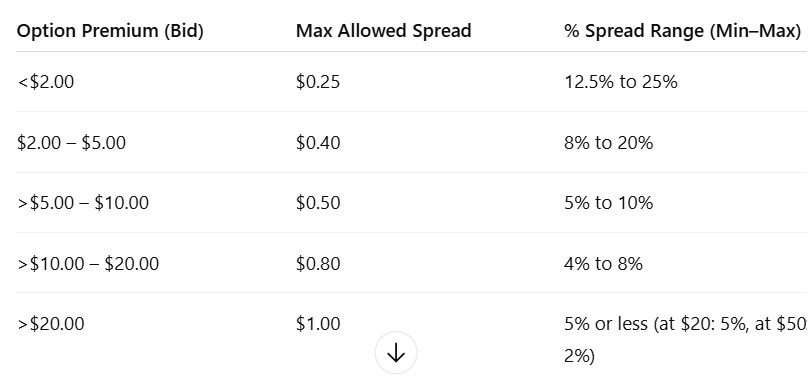
This should explain why OTM options (which are cheaper) have larger spreads than DITM options (which are more expensive), and also why SPYG options have larger spreads that SPY options.
Why the evil reputation?

I think that is is mainly because people don’t fully understand what market makers do.
When prices swing, trades are delayed, or spreads widen, retail traders sometimes blame market makers for rigging the system.
It doesn’t help that market makers work in the background, use complex algorithms, and profit from tiny price differences – it can all seem a bit shady.
The GameStop drama in 2021 only made things worse, even though the real issues were mostly about how the system is structured, not market makers themselves.
What happened with Gamestop?
First of all, you have to understand what happened during covid. The number of daytraders increased enormously. Robinhood gained over 3 million new users in the first 4 months of 2020. Average daily trades by retail investors doubled on many platforms (e.g., Schwab went from 500k/day to over 1 million/day).
Robinhood and similar apps attracted first-time traders with gamified interfaces and mobile-first design. Many users traded options and volatile stocks, over-confident and with little understanding of risk.
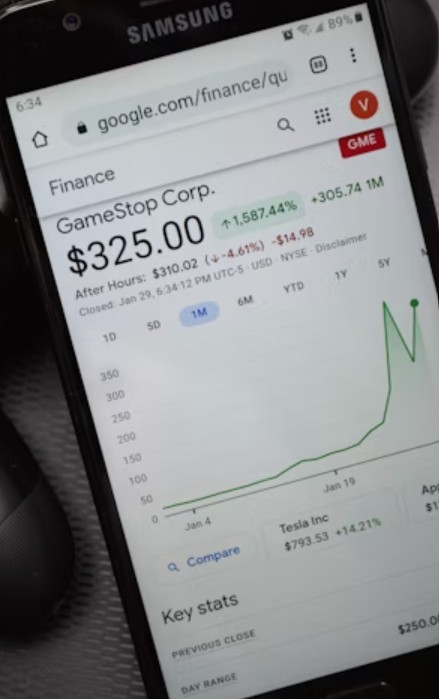
During the GameStop surge in January 2021, trading apps like Robinhood restricted buying of GME shares, leading to accusations that market makers like Citadel were manipulating the market. In reality, the restrictions were due to clearinghouse collateral requirements, not decisions by market makers.
How do Market Makers make money?
Market makers make money from the small difference between what they buy and sell for—the bid-ask spread. By executing large volumes of trades quickly and efficiently, they can earn consistent profits from these tiny margins. They don’t rely on predicting market direction—they profit from volume and efficiency, not speculation. It’s a volume game, not a gamble.
Who are the market makers?
The main market makers on the NYSE are called Designated Market Makers (DMMs). They are specialist firms assigned to maintain fair and orderly markets in specific stocks. Key players include:
- GTS Securities – the largest DMM on the NYSE, handling hundreds of listed companies.
- Virtu Financial – a global trading firm with DMM roles and electronic market making.
- IMC – active in both equities and options, and a registered NYSE participant.
- Jane Street – a major global liquidity provider with presence on NYSE and other exchanges.

These firms are responsible for quoting prices, managing order flow, and stepping in during volatility.If you want to read more about it, here it is from the horse’s mouth: https://www.nyse.com/market-model
To the markets
Last week was a pretty good – albeit short – week. All indices went on to make record highs. Nothing to complain of there!
SPY Charts
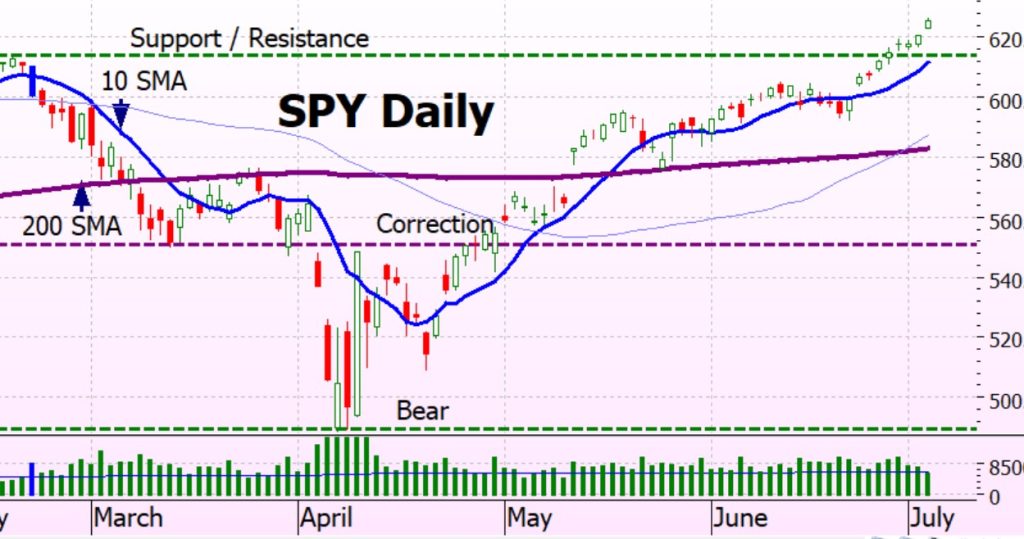
SPY has breached support and is in blue-sky territory. The volume was down slightly on Thursday, but that is to be expected as it was an early closing day. Apart from this the volume has been above average, showing that there is general support for the higher prices. How long will it go on? No idea, but I suspect that at some stage it will retrace and test 613/4 for support. But for now, all looks good.
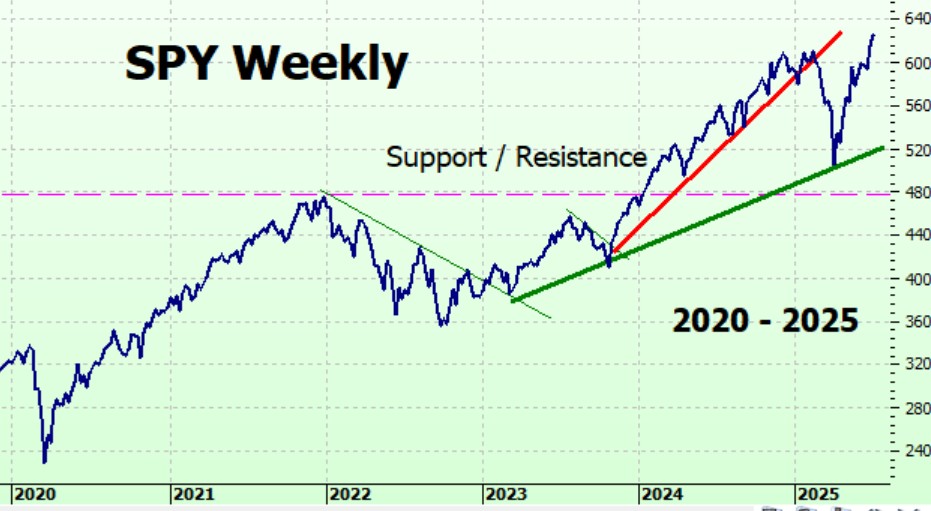
On the long term chart we see that SPY has well and truly bounced off the shorter-term uptrend (green), and is heading towards the longer term uptrend (red).
SPYG Charts
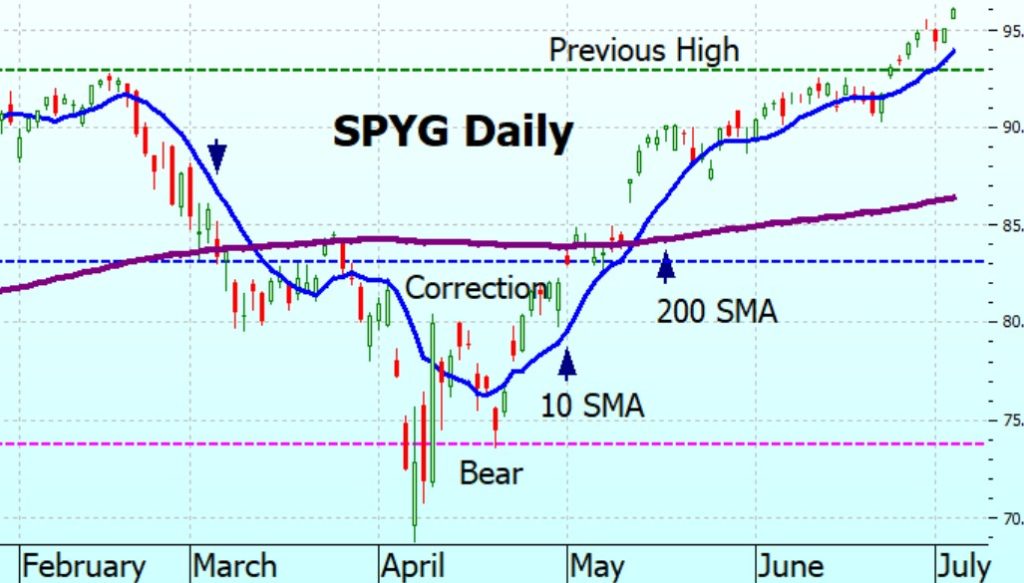
SPYG has also broken through resistance, and is in blue sky territory.
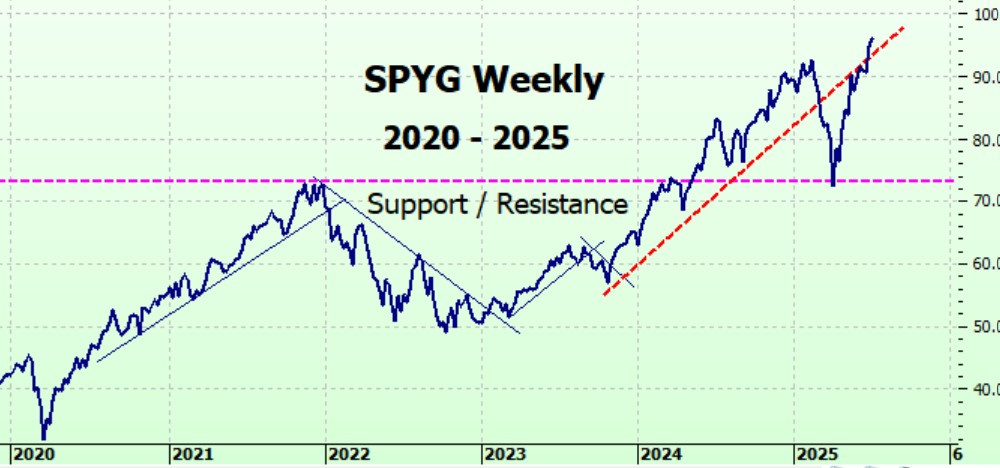
On the longer term chart we can see that SPYG is comfortably above the uptrend.
QQQ Charts
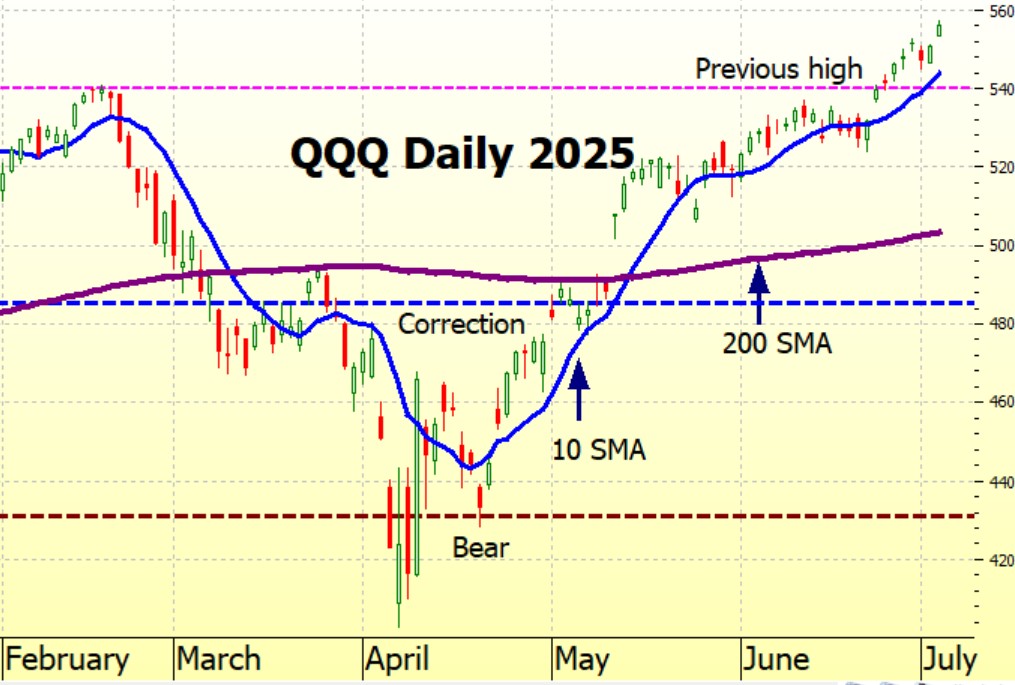
QQQ has been trading over the 540 resistance level for 7 trading days now – which is good. Although I am half-expecting a retracement to test it – but I hope I’m wrong!
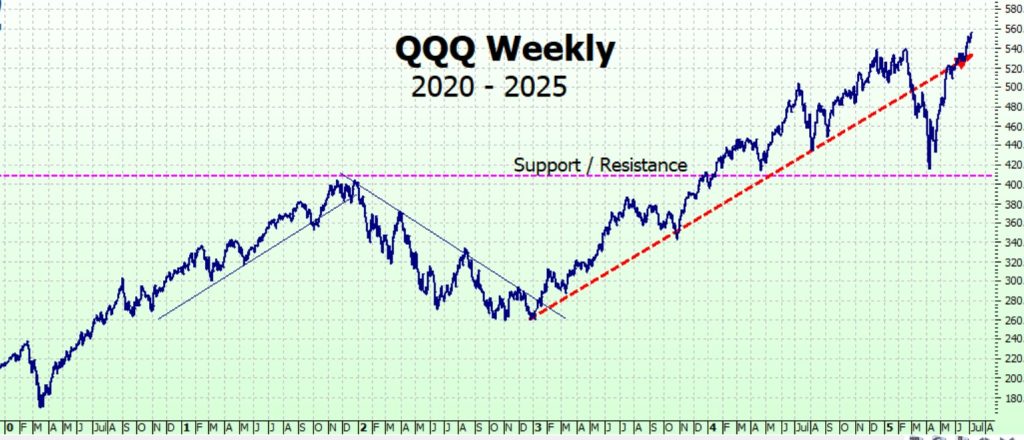
On the longer term chart we see that QQQ is now comfortably above the uptrend (red).
VIX Chart
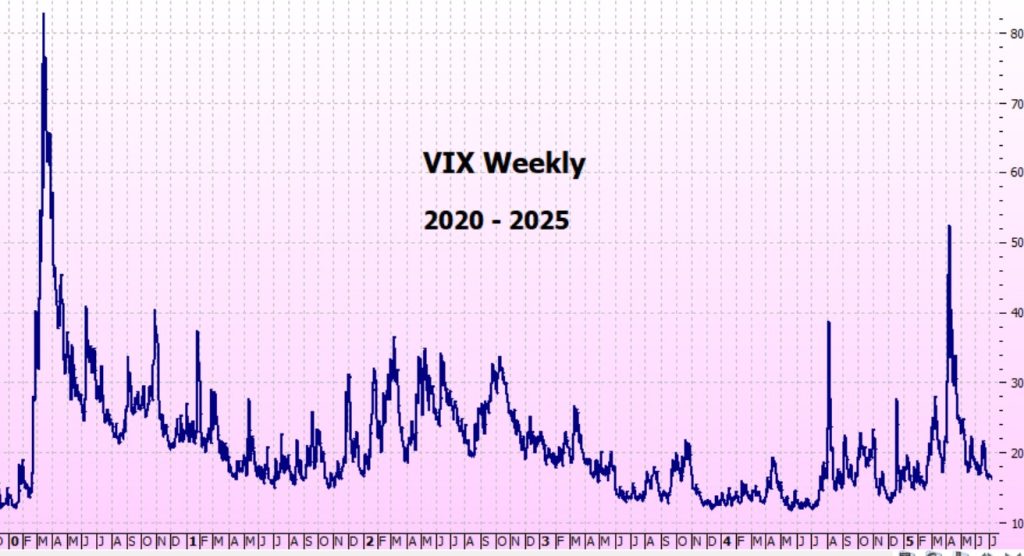
The VIX is back in low-volatility territory.
ITMeter

The week ahead . .
It’s quite busy, and a few things could upset the market. Here’s a summary:
- July 9 – Tariff Deadline
End of U.S. 90-day pause on reciprocal tariffs; new tariffs may hit non-deal countries. - July 9 – Fed Minutes
Release of June FOMC meeting minutes; clues on interest rate outlook. - July 10 – Earnings Reports
Notable: Delta (DAL), Conagra (CAG), Levi Strauss (LEVI). - Economic Data Releases
- July 8: Consumer Credit
- July 9: Wholesale Inventories, Crude Oil, Mortgage Apps
- July 10: Jobless Claims, Nat Gas Inventories
- July 11: Federal Budget
- July 8–11 – Amazon Prime Day
Four-day event; impact on retail and consumer sentiment. - OPEC+ Oil Output
Planned production increase; effect on energy sector and inflation expectations.
Apart from all that, nothing much going on!
The futures
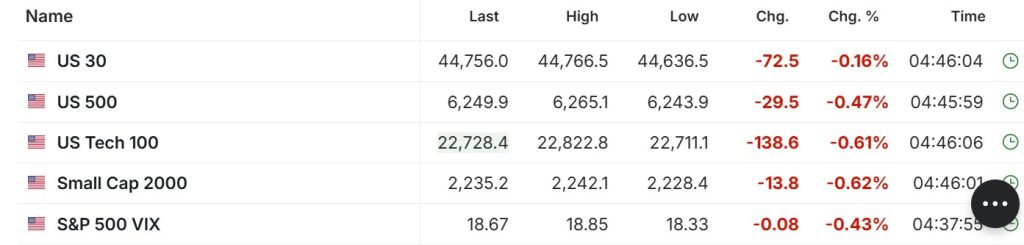
The futures are all down a bit, with the tariff deadline in focus – but it is still almost 5 hours to market open.
This blog coming to you from . .
The Arctic circle, somewhere in the Barents Sea. Yes, have left Svalbard with its polar bears and midnight sun! They take the bears very seriously – if you leave the (very small) town of Longyearbyen you have to carry a polar bear deterrent (flash or noise) and a rifle.


And yes, it really is me and I really was there – not making it up! (actually,the photo looks photoshopped, but its not!)

Fingers crossed for a good week!
Heather
Trade the tide, not the waves
Sorry this blog is late – the internet connection is slow and keeps dropping out. To be expected, I suppose. I am in the middle of nowhere.
Q & A
Related Posts
- Stock Market Update
As noted in last week’s post the charts are not flashing any major warning signals,…
- What a Boring Market!
Since the start of April, the stock market has been going sideways. While it is…
- Into a Bear Market
Into the Bear Market Finally, we got into a bear trade! After watching the market…

























18 Responses
Dear Heather,
Thank you for your weekly blogs as always. Speaking of leveraged, Bill Hwang of Archegos Capital was trying to increase his net worth from $1 billion to $10 billion to $100 billion by borrowing money from several major banks in the US and Europe and Japan. It works for him for a while until Goldman Sach started to liquidate his positions and everything collapsed.
Hey George – don’t know about that particular incident but sounds like an accident waiting to happen. Like playing heads and tail and doubling up every bet on the grounds that ‘ sometime there ill be a head ‘
Of course, as Keynes purportedly said: the market can remain irrational longer than you can remain solvent!
Very wise!
Hi Heather,
In your last article I posted a question regarding long-dated call options (2-3 years) and your reply was: “Buying long dated options is not a problem, but there are 2 drawbacks: 1) the cost – you are paying for time value you probably won’t need because: 2) in 2.5 years the index will probably have risen and if you bought a 50% strike then it may be down to a 30% strike (or less, depending on how much the index has risen).
This reduces you leverage which means that your profits will not be as great.
If you want to buy LEAPS (options 1+ years to expiry then if you still remember to roll up when your strike% reduces (even though you don’t need to roll out) then you should get the same results as ITM. Just that you are investing more than you need to.”
I really appreciate your response — your points are thoughtful and well taken.
I’m planning to run a variation of the ITM strategy. Instead of using a 10/200 SMA crossover for entry and exit signals, I’m using an EMA-based approach. After extensive backtesting on BackAlpha.com, I found a parameter combination that offers both higher annual returns and lower maximum drawdowns. The average holding period in this version is about 2.5 years.
In that context, buying long-dated call options isn’t “paying for time value you probably won’t need” — the full duration is likely to be used. There’s also a tax benefit: if the holding period exceeds one year, gains qualify as long-term capital gains since SPY options are equity options.
I plan to initiate positions with 3x to 4x effective leverage. Even if that leverage declines to 2x or 3x as SPY rises, the exposure remains meaningful. Additionally, I prefer to avoid frequent rolling, as it introduces slippage and bid-ask spread costs. Fewer rolls also mean less maintenance, less attention, and lower stress — which aligns well with the long-term nature of the strategy.
Hey Tyler – if you have found a new strategy – great! Go for it! I would just caution about 3X and 4X leverage – if things move fast this could be disastrous. But I expect you have already thought of this and have a plan in place.
Good luck, and let us know how you go.
h
Good day Heather, Is the ITM Bull market book version on this website different from the Amazon version. This website shows 2024 on the cover , however the Amazon site does not have 2024 label and shows publication year as 2020.
Hi Jeff – the 2020 date is the date it was first published. It should be the same as the date on the cover, and you can check by the copyright date inside. If that doesn’t say 2024 get back to Amazon and tell them – but I haven’t had any other complaints so I suspect all is OK.
hope this helps.
h
Good day Heather, In the ITM Strategy, for SPY currently at 620, it is not possible to buy using the 1% time rule as the premium is very expensive for options 1 year out . The 1 year out, Sep26, premium for 300 strike is $333, which puts the effective price at $633 which is about 2% time. Other suggestions like 60% strike price (currently no Open Interest) or 85% Delta (500strike+$153 premium) etc does not seem like good candidates either. What strike and duration is optimal to buy for ITM strategy at present. Thank you.
Hi Jeff,
I’ve been analyzing the relationship between leverage and time value, and I’ve come to an interesting observation: the annual time value cost appears to scale roughly with the level of leverage. For example:
At 2x leverage, the time value is about 2%
At 3x leverage, it’s around 3%
At 4x leverage, closer to 4%, and so on.
This assumes you’re buying SPY call options with about one year to expiration. In this context, 2x leverage means you’re paying 50% of the stock price for the option, 3x means 33.3%, 4x means 25%, etc.
Based on current pricing, achieving a 1% time value cost isn’t feasible. It may have been possible in the past, but not in today’s environment.
Hi Tyler – thank you for this. As I am on holiday and working on a silly little laptop O can do anything in the way of backtesting or calculations at the moment – but will have a look when I get back in August!
h
Hi Jeff – sorry for the late reply. This requires me to login to a secure network, which I can’t do right now. Should be able to this evening , I will answer then.
h
The polar bear is a relative of the brown bear… and when you hunt it – it can turn around and hunt you.
When you buy or sell your option/s do you set a price and wait till the order is filled or buy & sell at market…
In a declining market you’re kinda stuck holding a expiring order…
r
Hey Randy – didn’t actually see any polar bears, they don’t often come into the town – although I used the binoculars to scan the hills didn’t manage to spot any.
Re buying / selling – I put in a limit price then watch the action for the next 10 minutes or so. If it isn’t filled in that time I change the prie and do the same again – then I get irritated and change to market!
Schwab have the best price guarantee, and when buying I usually set my limit at the ask, and get filled much lower, often below the halfway mark. Doesn’t work so well when selling though.
Hope this helps.
h
Heather. Up there, wherever you go is south.
Today was Implementation Day. Ive gone Full Heather!
Just finished Reminiscences, and starting if again. Good stuff.
Many blessings.
Hey David – yes, on way south. And yes, i love Reminiscences too. Actually, I traCked down a book about Livermore, but it was a secondhand hard copy so i had to leave it at home, will read when i get back.
I see that the market has opened down – s probably a good day to get in. Fingers crossed!
H
Hello,
would you please educate me how many months prior the expiration date should I consider rolling over my SPYG option?
Thanks
Tipizo
Hey Tipizo,
I always recommend rolling around 4-6 weeks before expiry, even with DITM options.
Hope this helps.
h
Thanks as always!
Thank you Blake!
x
h