


Dumb Money to Market Force.
Up until recently, individual traders were overlooked in the stock market. What mattered were the professionals – the big banks, money managers and institutions – all with very deep pockets that individual traders couldn’t match. Those deep pockets paid for resources: technology, research, brokers. This was the so-called smart money.
Dumb Money

And the ‘dumb money’? That was us, individual investors, without those resources, relying on instinct and guesswork. Our trades were barely big enough to register. Trading wasn’t easy, or cheap. You rang a broker, paid eye-watering commissions, and then waited in line behind the big clients while they placed your trade. Options were considered exotic and dangerous, best left to professionals.
The Mouse Who Roared
In recent years the picture has changed totally. We – the former ‘dumb money’- now have access to tools that were once the province of professionals. Real-time charts, instant execution, zero-cost trades – and options approvals are now routine rather than restricted.
I remember years ago having to pass a test before I was allowed to trade options – anyone else remember that?
Even now, Schwab will not let me trade spreads on my retirement account (too dangerous apparently), but is fine with my doing it in my individual account. In any case, you can ‘leg into’ a spread – the rules permit that – but you can’t do it in a single trade. Go figure. (see footnote)

Covid Lockdowns
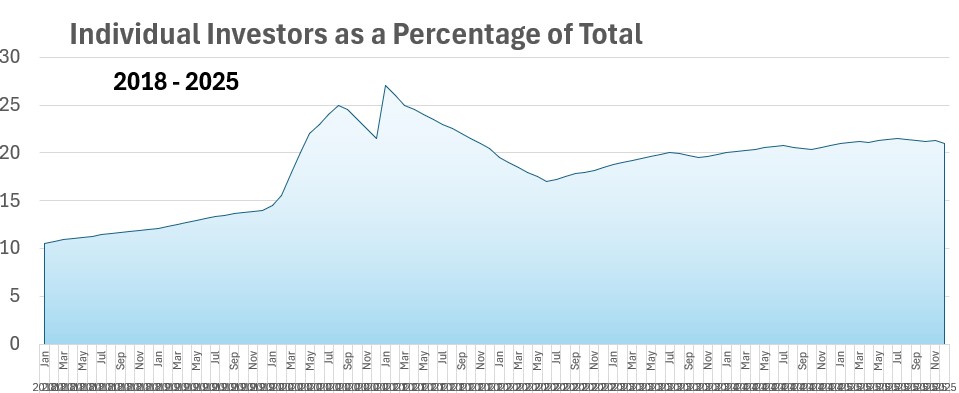
Then came 2020. Lockdowns, stimulus payments, sharp market swings and a lot of idle time pulled a huge wave of new participants into the market. Many were first-timers. Some left as quickly as they arrived. But retail participation never returned to pre-2020 levels. Retail trades now make around 22% of trading volume in October 2025 – it is still not quite as high as during the pandemic, but it is getting close.
Market Saviors?
One advantage individual investors have is that they aren’t bound by quarterly targets. They don’t feel forced to sell simply because the market has a wobble.
This freedom may have contributed to quicker recoveries from downturns.
We saw this during Covid, when individual investors were busy dip-buying while institutions were rapidly ditching their “underperforming” stocks.
More recently, during the 2025 Tariff Tantrum, retail traders poured around $40 billion into equities in a single month – helping to kick-start the rebound.

What does it mean for ITM?
Surprisingly little. ITM isn’t dependent on who is trading, or how noisy the market feels this week. It’s based on the tide, which doesn’t change because there are more waves on the surface. Increased retail trading can increase short-term volatility, especially around options expiry, but it doesn’t alter the underlying tide.
The rise of the retail trader has changed who is in the market. It hasn’t changed how the market actually works.
To the markets . . .
We’re just getting back into the swing of things after the Christmas / NY period. Not a lot is happening, and the markets seem pretty calm. Tempting fate here, I realise.
SPY Charts
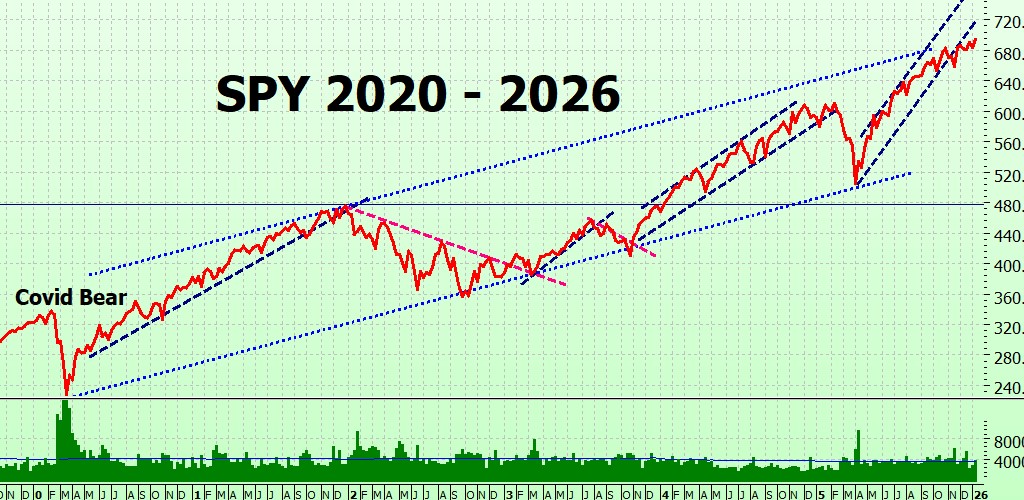
SPY has been making new highs. Nice. Although you wouldn’t know it from the financial press. Where are all the headlines?
Last week we drew in a box – and guess what? We broke out of it on the upside. Not on huge volume, admittedly, but not everyone is back from holidays last week. All looking good. Although I notice that 700 is looming – markets often (but not always) have trouble getting through round numbers like this.

On the long term chart we are still out ot the previous trading channel – but I can see another channel, starting mid 2025, forming. But as I noted last week, lines are subjective and you can end up ‘seeing’ all sorts of things that may or may not be there. Whichever way you look at it, the trading channel is no longer useful for us so I will remove it from the chart next week.
SPYG Charts
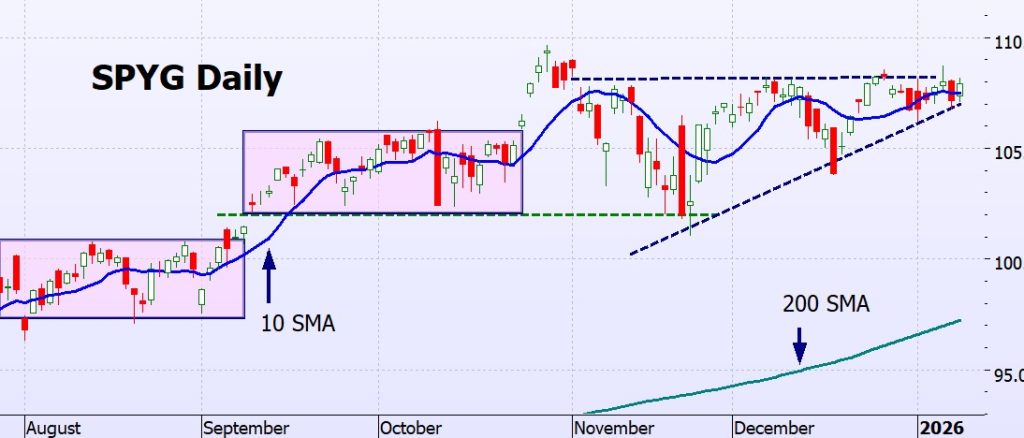
Talk about being at the pointy end! We are right at the end of the upward triangle we drew in a few weeks ago. Conventional wisdom says that this should break upwards – well, we’ll find out in the next few days!
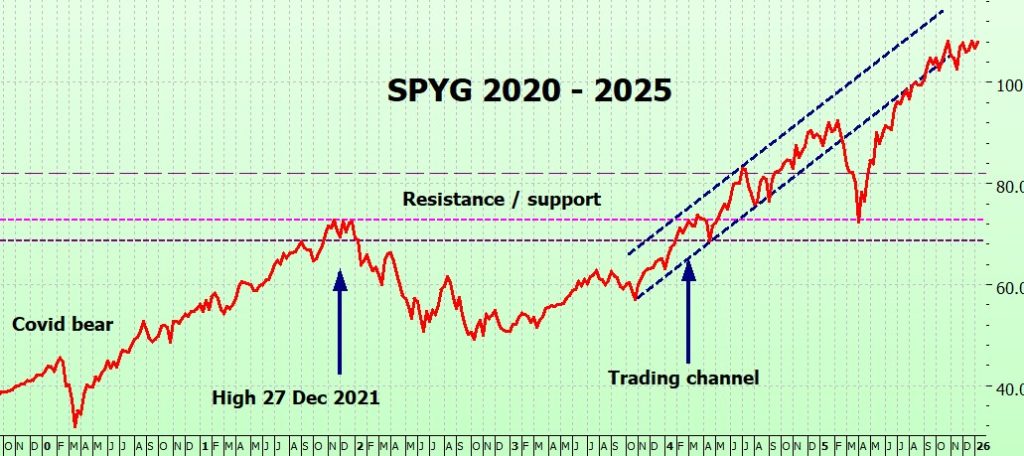
Longer term, SPYG is still clinging to the lower bound of the trading channel.
QQQ Charts
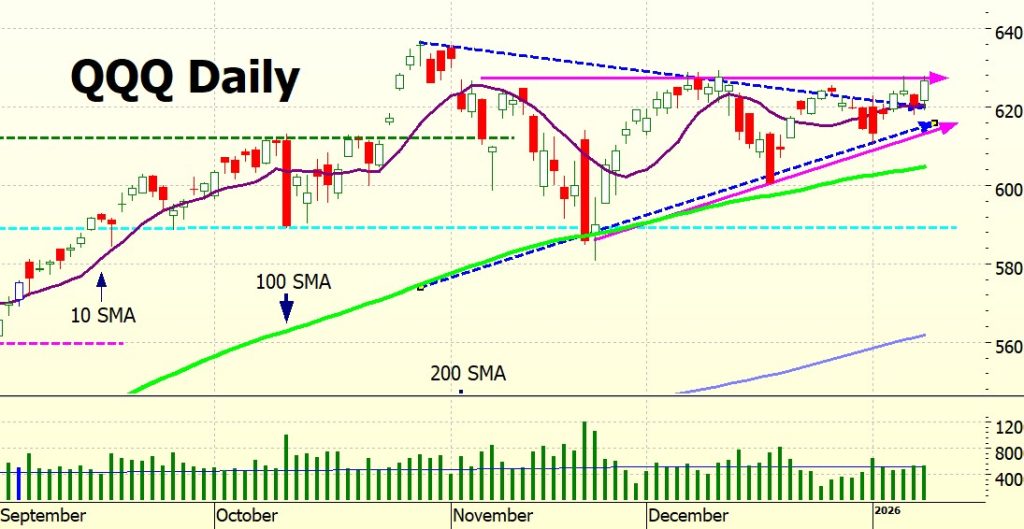
QQQ – a very busy chart. As I pointed out last week, the blue dashed line is the symmetrical triangle, theoretically just as likely to break to the downside as the upside (talk about hedging your bets – of course it is going to go up or down!!) Well, it looks as though we have broken to the upside – not on a large candle or high volume, but have closed above it for 4 days.
The upward triangle is still in play – have to get over around 628 to have a breakout. Let’s hope it happens.
(I am regretting ever drawing in these lines – I fear they are not helpful, so I will remove some for next week.)
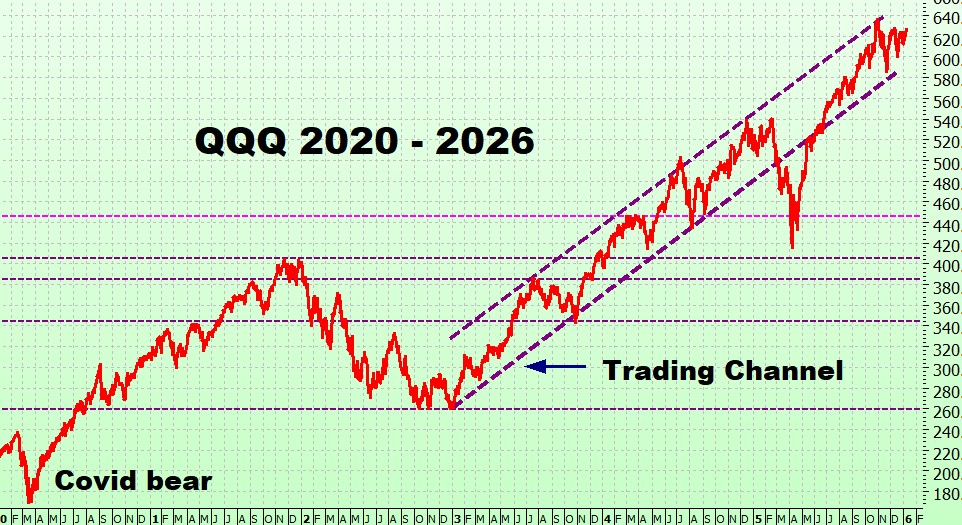
On the long term chart all looks quiet.
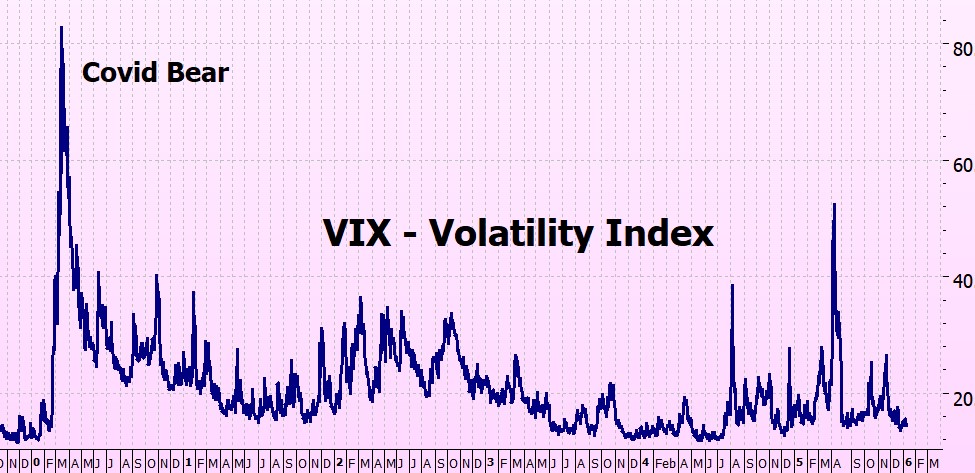
VIX Chart (Volatility)
Still in low volatility territory.
ITMeter

The week ahead . .
A few announcements
- Tuesday Jan 12: S. Consumer Price Index (CPI) Headline CPI and Core CPI (ex-food & energy) for December are released. This is the first full inflation read since the government shutdown disrupted regular reporting.
- Wednesday, Jan 14: S. Retail Sales (November/December). Producer Price Index (PPI), Business Formation Statistics (December)
- Thursday, Jan 15: Initial Jobless Claims (weekly)
- Friday, Jan 16: S. Industrial Production & Capacity Utilization
The Futures
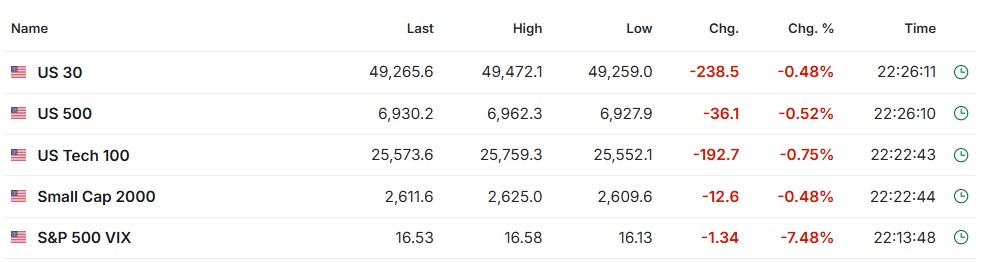
The futures look a bit dreary – what could that be about? I notice that Powell is making headlines about a DOJ inquiry – surely not that? Iran? Nothing new that I can see. Here they are:
Fingers crossed for a good week!
Heather
Trade the tide, not the waves
Q & A
Footnote:
When checking my facts before publishing, I discovered that this issue isn’t technically at Schwab’s discretion. Spreads are generally restricted in retirement accounts because they are treated as margin trades, while retirement accounts are cash-only under IRS rules.
My account is not an IRA, yet remains subject to the same restriction — and Schwab have declined to discuss why.
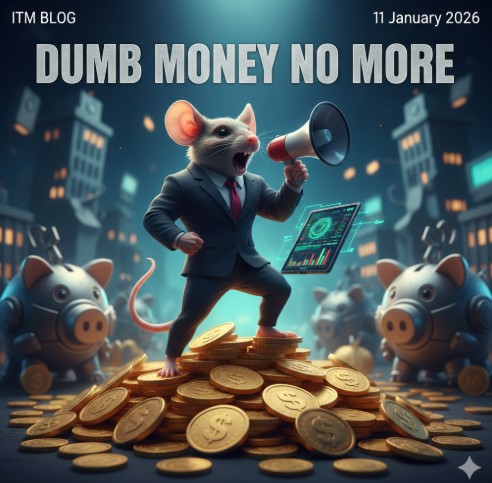
While I was checking it I asked AI to make a heading image – here ’tis:
Related Posts
- Gamification
Brokers Win. Traders Lose. Your broker doesn’t make money when you make money. It makes…
- Trading the Bear Market
So the Bear Won! There’s no doubt about it: we are in a bear market.…
- Bull Euphoria?
The Start of Euphoria? I started to feel a bit twitchy recently. Too many positive…

























13 Responses
I enjoyed your books several years ago and returned to review the backtesting results. Unfortunately, there are no longer any pdf’s linked to that page (heathercullen.com/backtesting/) and I wondered if they might still be available. Thank you for any help, Jay
HI Jay,
Yes, the old backtesting has disappeared – the new backtesting is up, but I am waiting for it to be audited and verified. To see it just google ‘heather cullen backtesting’.
It is the first part of a big new all-singing all-dancing Reader Hub to go with the new book.
Oops – and I have just realised that the links to all the pages have not been set up yet – they are:
Backtesting
Methodology & Assumptions
Bull Market Backtesting SPY,
Bull Market Backtesting SPYG,
Bull Market Backtesting QQQ,
Bear Market Backtesting
If you google them you should find them – but probably best to wait until the new book is published? Then you would know exactly what you are looking at.
Hope this helps
h
I can trade spreads in my Fidelity IRA. It’s a permission called “Spreads on IRA”.
HI Jeff – I actually don’t find it that much of a drawback – i rarely use spreads and can do them in my individual account anyway. It is just annoying as my superannuation account is a PLC, so should not be affeccted. But you have to pick your battles and I feel I am not going to win this one.
Maybe they are just being mean because I am an overseas customer!
Byt thank you for the info!
x
h
I agree that you have to “pick your battles” with the various brokers. I use two and one approved me for Tier 3 options trading rather easily. The other would not approve beyond Tier 1 (simple puts and calls). When I called I was sent to an “expert” and that “expert” said that he know what was best for me better than I did (translation – he had been trained to avoid any/all possibilities of an SEC investigation). I get their concern — but I just wish there were some consistency among the brokers. Their first concern is not what is best for the customer, it’s protecting their own hiney. But after an 18-month venture into all kinds of options strategies, I also learned that the DITM strategy is really all that one needs. I made some $ on other strategies but the “earnings per hour” I’m sure was paltry. I got worn out and was spending too much time on it. Valuable lesson learned! God bless.
Hey Brad – you too!
and re ‘earnings per hour’ – I think the worst one I did was writing options against CFDs. It involved adjusting the position whenever it became perilous – and that alert happened every night (trading from Australia) for around 3 weeks. often several times in a night – you would get back into bed just be falling asleep when – beep beep beep – and you had to drag yourelf out of bed again.
At expiry the trade was touted as ‘successful’ – and I made the magnificent sum of $13.
Hard to beat if you translate it into $ per hour!
x
h
Dear Heather. I have two questions regarding the In The Money strategies and would really appreciate your clarification. 1. Extra indicator (ITM – first book) Although this was mentioned in In The Money Bear Market, my question relates to the original In The Money bull strategy from the first book. In ITMB, you note several times that adding one extra indicator would have made the results even better, but that you intentionally did not include it in order to keep the rules exactly as originally published (e.g. Chapter 3 Beating the Market and Chapter 10 Bulls and Bears Together). May I ask which indicator you had in mind? 2. Strike selection in the current market In In The Money, you suggest buying call options roughly 50% ITM, and in ITM Bear Market about 35% ITM for puts. In today’s market environment, these deep ITM options are often very expensive, and in the case of puts such strikes are sometimes not even available. Do you have any updated guidance on how far ITM you would recommend going under current market conditions? I would also like to say that I found your books extremely interesting and refreshingly different from most of what is commonly sold in the trading and investing space. I noticed on your website that you enjoy traveling to Europe. If you ever happen to visit Prague (in my opinion, the most beautiful city in the world ), please let me know — I would be very happy to invite you for a coffee. Thank you very much for your time. Best regards, Vojtech
Hi – thank you for your kind invitation – I have never visited Prague, I always seem to find myself gravitating towards France – and Switzerland and Italy and Greece. I need to braoden my horizons!
To Business:
1. Re the extra indicator – it was the MACD but the problem with the MACD is that it is not normalized, so values will change as SPY (or SPYG or QQQ or any stock / ETF) increases . Yes, it can be normalized, but that is not standard for any graphing package, so it makes it hard to use. So much so that I have entirely changed the bear strategy in the new book so that reliance on the MACD is reduced to a minimum. I felt it added a layer of complexity that for the increase in return was just not worth it.
2. Yes, this is something that I am aware of – Option strikes are made around 2 years in advance, and often don’t take account of how much SPY can move in a year. Re calls – this does not matter so much as there is no shortage of DITM strikes. However, puts are a different matter – and I have addressed this in the latest book, using up to date options chains (September – November 2025)
I understand that people have already bought the 2024 update book, but I would really like everyone to get the new book, it has been designed to answer most of the concerns and questions raised, and has been – as much as possible – future-proofed. It will be at the lowest prices that Amazon will allow, just enough to cover printing / delivery (yes I get charged for them to deliver an eBook!) – it certainly will not be a money-making exercise for me, and I hope everyone understands the situation.
Hope this helps – pls get back to me if I haven’t answered your question.
H
I thought the option strikes were supposed to be 6-9 months out, not 2 years as you said in this answer.
Hi Jimbert
you misunderstand me – I meant that the STRIKES were made some two years in advance.
I was talking about the NYSE’s mechanical ‘pre-planning’ process—they map those strikes out years ahead of time as part of their standard housekeeping. It’s definitely not a suggestion to actually buy options with two years to expiry; in fact, my point was that because the exchange sets them so early, those strikes are often totally out of sync with where the SPY actually ends up.
Nothing has changed in the ITM strategy – 6-9 months to expiry is fine.
h
Thank you so much for your detailed reply – it’s very helpful.
I just wanted to clarify one point: my question about the extra indicator was regarding the original Bull Market strategy from In The Money, not the Bear strategy. I understand now that you were referring to the MACD as a potential improvement to the Bull strategy, while the Bear strategy already includes the MACD histogram. I apologize if my earlier question was unclear.
Detail from the ITMB book: chapter 3 – Beating the Market: „Keep the exact ITM rules that I had published in ITM almost a year before. (i.e., not adjusting ITM to include an extra indicator although that would have made the results even better!)“ and again in chapter 10. Bulls and Bears Together „The ITM bull strategy had to have no tweaks or alterations, even though I could see how using an extra indicator would make it even better. In this way, because I was using the rules exactly as set out in the first In The Money book there could be no doubt that the results were correct, and the rules not massaged in any way.“
Regarding strike selection, I completely understand, and I’m happy to wait for your upcoming book for updated guidance. I’m really looking forward to it.
Thank you again for your time and for sharing your insights.
Best regards,
Vojtech
Hey Voytech – I think it will be worth it. Just looking at the final proofs today, and am very pleased with them.
I hope you think so too!
x
h
Thank you very much for your detailed reply — I really appreciate you taking the time.
I may not have explained my first question clearly enough, so please let me try to clarify. My question about the extra indicator relates specifically to the DITM bull strategy from the original In The Money book, not to the bear strategy itself.
What prompted my question are the following statements from In The Money Bear Market:
In Chapter 3 – Beating the Market, you write:
“Keep the exact ITM rules that I had published in ITM almost a year before (i.e., not adjusting ITM to include an extra indicator although that would have made the results even better!).”
And again in Chapter 10 – Bulls and Bears Together:
“The ITM bull strategy had to have no tweaks or alterations, even though I could see how using an extra indicator would make it even better.”
Based on these passages, I understood that there was an additional indicator that could have improved the original DITM bull strategy, but which you intentionally did not include in order to keep the rules unchanged. That is the indicator I was asking about — I just wanted to make sure I understood that correctly.
Regarding the second point on strike selection: thank you for the clarification. I will wait for the updated guidance in the new book you mentioned. In the meantime, if a bear market were to occur, I would follow the DITM approach using put options that are deep in the money based on price and availability, applying the 1% rule as described.
Thank you again for your time and for sharing your insights.
Best regards,
Vojtech