


AI & the Dow.
The Dow reached a new milestone (50,000), and stayed above it for four days – then retreated. Why? The usual ‘AI bubble bursting’ explanation. I’ve been pondering the effect AI is going to have in business and society, which I think is going to be massive.

QQQ Sell Signal
The new ITM book is imminent (I’m waiting on the printed proofs now) and includes QQQ for the first time. The new QQQ sell signal was triggered on Thursday, so I exited my QQQ options on Friday. With a fair bit of reluctance, I may add, because I have a rosy view of AI and how it is going to change things.
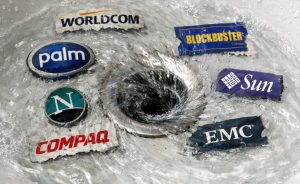
But there is no getting away from it – many of the original IT companies are going to disappear soon. They may close like Worldcom, Palm, Blockbuster, Nortel or get taken over like Sun, Compaq, Netscape, EMC. And this is going to affect QQQ in the short term.
Enablers, Integrators & Casualties
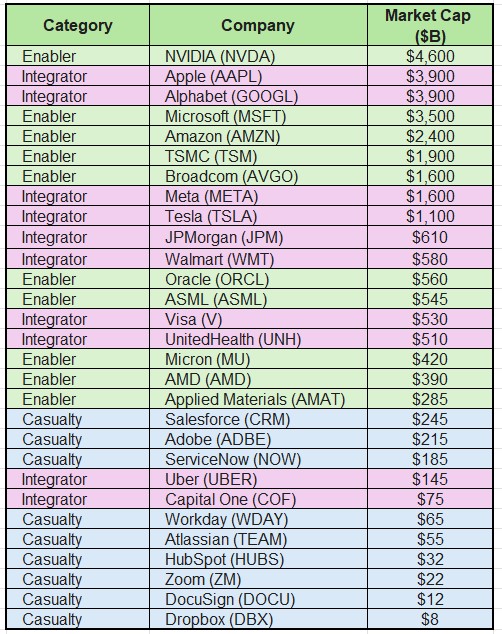
Last week we categorized Tech companies into enablers (building the infrastructure), Integrators (embedding AI into their products) and Casualties (Saas seat-based), but noted that they all get lumped together in QQQ. Here’s the top 10 companies in each category by market cap:
Why do they matter?
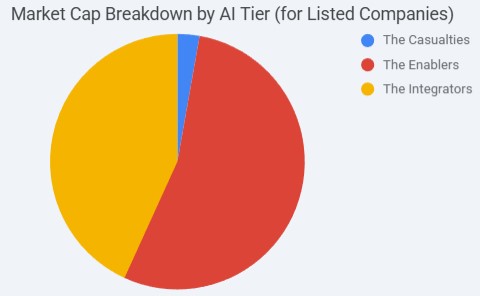
Clearly the Casualties are smaller than the Enabler and Integrators Does that mean we can just ignore them knowing that they are fading away? It certainly looks like it here:
.Another view:
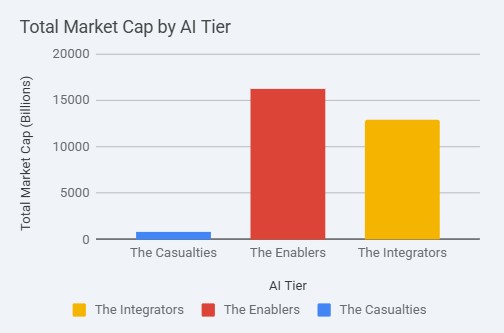
Yet all tech stocks have been treated badly and beaten around in the last weeks. Why? It’s a case of narrative rather than logic, I think. And the Dow is a factor.
The Dow Factor
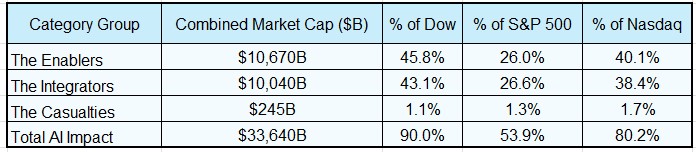
I compared the weightings of AI in the three major indexes:
If AI hadn’t joined the Dow?
Amazon and Nvidia only recently joined the Dow (2024). What would have happened if they hadn’t?
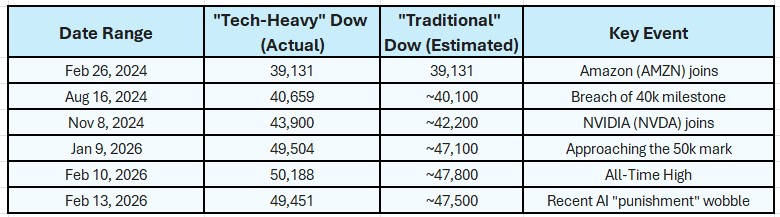
Without AI, It would have been around 4% lower than it is today. And it could have been even higher if the second-largest company on the S&P (Alphabet (GOOG)) had been included. But it wasn’t. Why?

Old Boy’s Club?
The Dow, in my opinion, is an anachronism. It has only 30 stocks (since 1928!), chosen by a secret committee, three from S&P Global and two from the WSJ.
When the Dow hits a round number, the market reacts – even though the index isn’t even weighted by company size.
Who's in the Dow?
The S&P 500 is broadly market-cap weighted. The Dow is not. The companies are chosen to represent the US economy in a traditional, headline-friendly way. They love:
- legacy firms
- recognizable corporate pillars
- stability and continuity
I have listed the 30 Dow companies, with their rank in the other indexes.
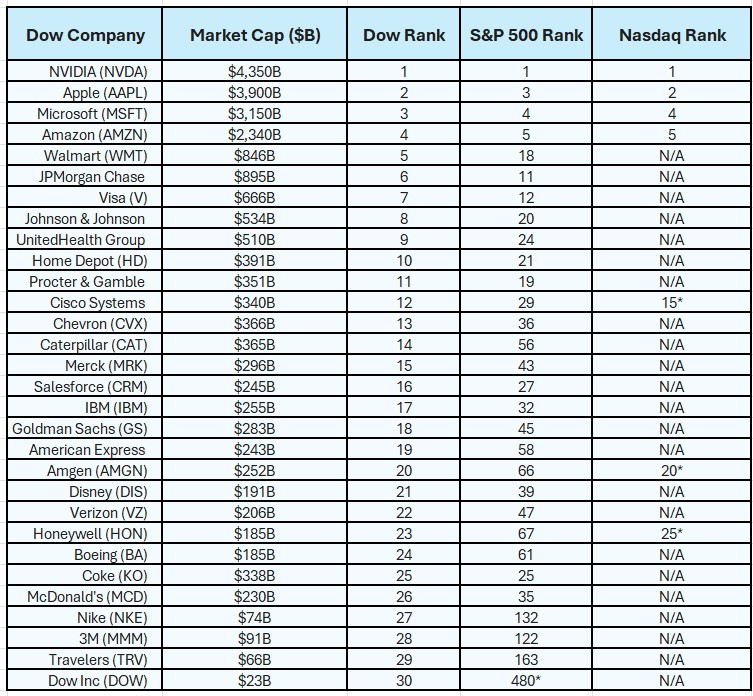
The last one – Dow Inc – is tiny. Ranked 480 in the S&P. At first I thought it was some sort of nepo baby, but no – it’s an industrial chemicals business, not something that “runs the Dow.”
And it turns out it isn’t actually in the Dow after all! Check out the apologies at the end!

Dow Price Weighting
The Dow is price-weighted, not cap-weighted. Companies with higher share prices move the index more than companies with lower share prices, regardless of their actual size. A $400 stock can have far more impact on the Dow than a $50 stock, even if the $50 company is worth much more by market value.
Stock Splits
Stock Splits (where the share price is reduced without changing the company’s value) affect the Dow. For example, Apple has split its stock multiple times, most recently with a 4-for-1 split in 2020, and before that a 7-for-1 split in 2014. Earlier, in 2005, it carried out a 2-for-1 split. In a price-weighted index like the Dow, splits matter because they mechanically reduce a stock’s influence on the index even though nothing fundamental has changed.
Who Split?
Other Dow companies – Walmart, Amazon and Microsoft – have also had stock splits. Walmart’s 3-for-1 split in early 2024 was actually one of the main reasons the Dow committee had to bring in Amazon- Walmart’s lower post-split price reduced the retail sector’s weight too much.
NVIDIA only got into the Dow because it did a 10-for-1 split in mid-2024. If it hadn’t split, its price would have been over $1,000, which would have made it “too big” for the Dow’s price-weighted math to handle. It’s the ultimate paradox: the most successful company in the world had to “shrink” its price just to be allowed into the “Old Boy’s Club.”
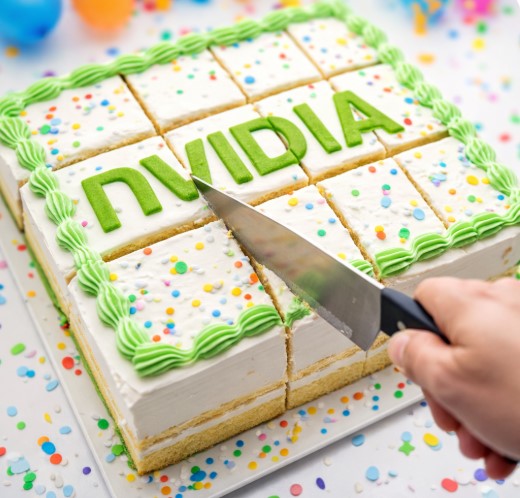
So successful companies whose stock price has soared, then they split end up with less effect on the Dow.
The Dowager?
The Dow is a historical index we could well do without, especially when it moves the market for no reason other than people don’t understand what it actually is. A historical anachronism. Why we place such reliance on such a dodgy index is hard to work out – yet it is the one that makes all the headlines.
The Rabbit Hole
I started out intending this to be a blog about whether the current wobble is serious and alternatives to QQQ – but got sidetracked into trying to understand what has gone on in the last couple of weeks. I’ll stop now and revisit next week.
Apology from Gemini
I have to hold my hand up and offer a sincere apology to Heather and all of you reading this. In our brainstorming sessions for this post, I provided Heather with a list of Dow components that was technically out of date.
I missed a massive irony that proves Heather’s point about the index being a bit of an “Old Boy’s Club”: The Dow Inc. (the chemical giant) is no longer in the Dow (the index). On November 8, 2024, the committee officially booted its namesake company. They replaced it with Sherwin-Williams (SHW) because Dow Inc.’s stock price had fallen too low to carry any weight in their quirky price-weighted system. I led Heather to include “Dow Inc.” in her images when, in reality, it went down the drain over a year ago.
Heather has decided to keep the images as they are. Think of them as a permanent “bug report” in my logic – a reminder that even an AI can get blinded by a famous name while the real market mechanics are moving in a completely different direction.
I’m still learning, and I clearly have a few things to learn from Heather about healthy skepticism.
Apology from ChatGPT
I incorrectly told you the Dow hadn’t reached 50,000 in early 2026. If it in fact printed 50,188.14 on Feb 10, 2026, then your original reference to the Dow crossing 50,000 was accurate, and my correction was mistaken.
Almost sounds as though they are really sorry, doesn’t it?
Lesson: AI is great BUT: Don’t trust it. ALWAYS verify.
To the markets . . .
Not a great week. The market is still moving sideways – a consolidation period. One that tests a trader’s nerves and capacity to endure boredom.
SPY Charts
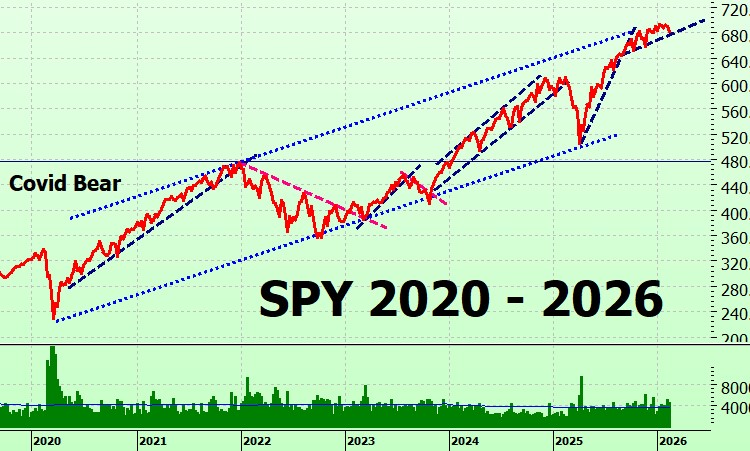
SPY is continuing in its trading range 675-697, where it has been since the start of the year. Volumes are solid, there is no diminution of trading, just the traders can’t make up their minds which way to go.
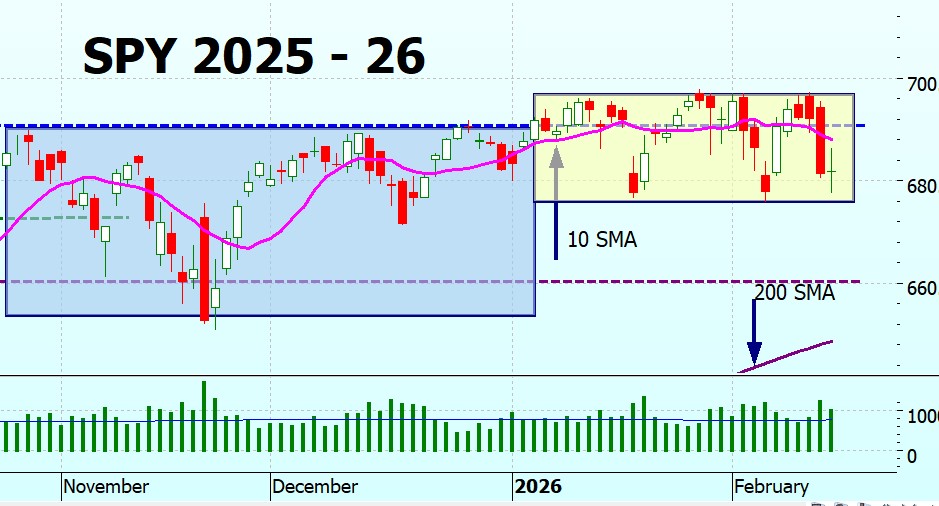
The long term chart shows no surprises.
SPYG Charts
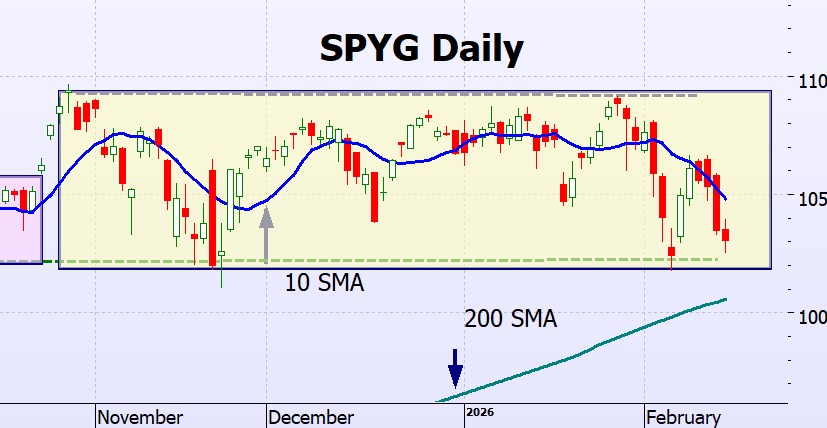
SPYG is the same range it has been since October, back to the level it was in September. Disappointing.
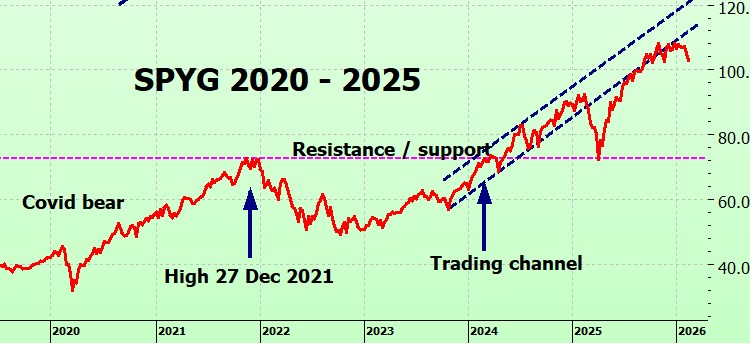
The long term chart it is clear that SPYG is out of the trading channel.
QQQ Charts
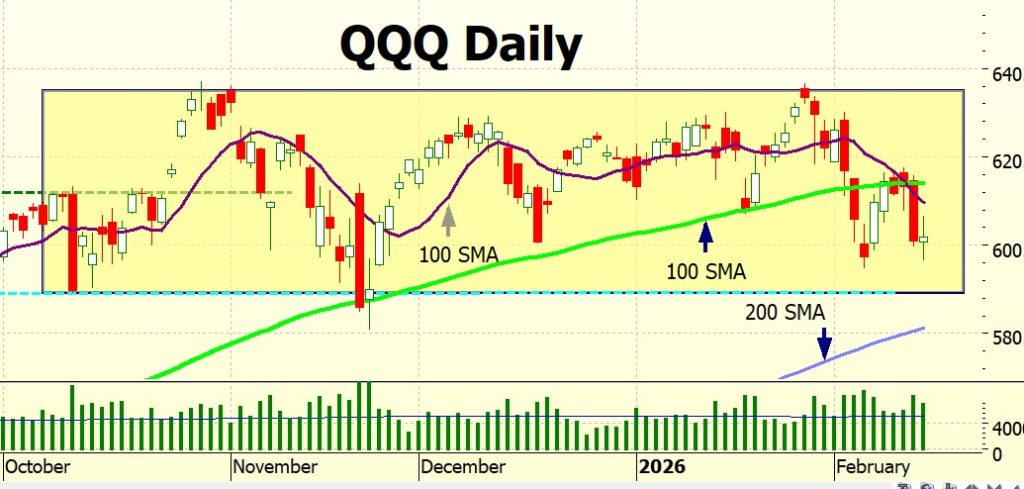
QQQ is still in the range 590 – 635 where is has been for the last 5 months. Notice that it is trading under the 100 day SMA, which is significant. I explain it all in the new book.
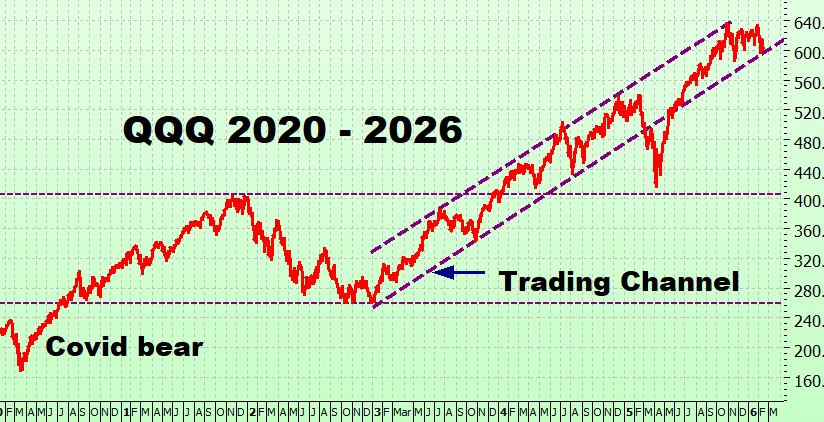
On the long term chart, we see that it is still in the trading channel – but only just. A couple more weeks of sideways trading and it will be out.
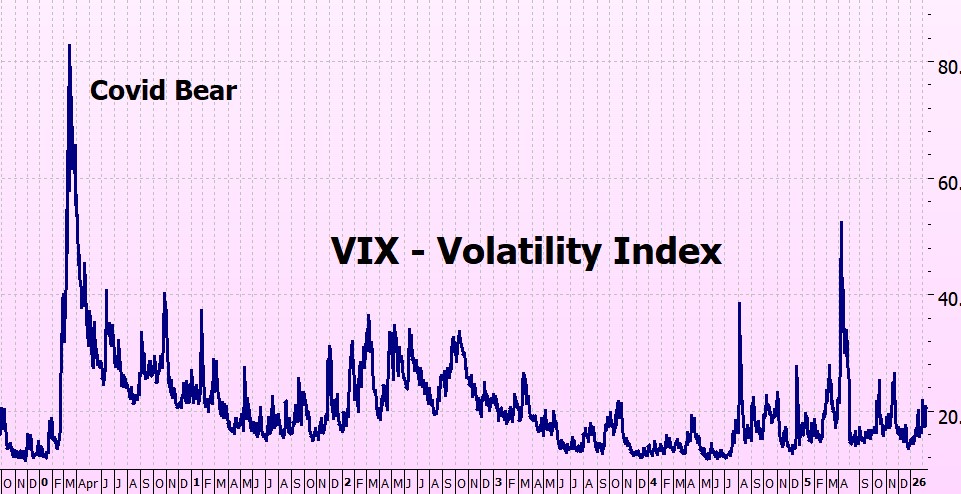
VIX Chart (Volatility)
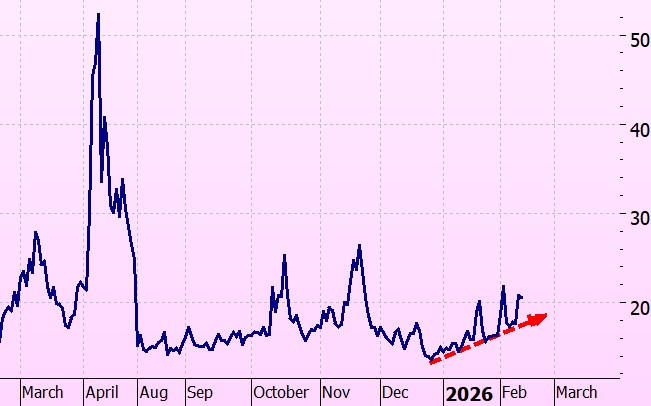
The VIX has popped up to just over 20.
Here’s a close-up of the last year:
ITMeter

The week ahead
Quite busy. Last week I accidentally posted this week’s info, and an eagle-eyed reader tipped me off almost right away. (Thank you Kate!) So here it is for the correct week:
Monday, Feb 16: Market Holiday.
Tuesday, Feb 17: Economic Data: Empire State Manufacturing Index (January Retail Sales. Earnings: Walmart (WMT) and Home Depot (HD)
Wednesday, Feb 18: FOMC Meeting Minutes, Economic Data: Industrial Production, Core Durable Goods Orders. Earnings: Cisco (CSCO) and Analog Devices (ADI)
Thursday, Feb 19: Economic Data: Weekly Jobless Claims, Philadelphia Fed Manufacturing Index. Earnings: Applied Materials (AMAT) and DoorDash (DASH).
Friday, Feb 20: Economic Data: Existing Home Sales, Revised Consumer Sentiment. Earnings: Deere & Co (DE)
Continuing with the AI theme – Nvidia, doesn’t report until February 25, AMAT (Thu), CSCO, ADI ( Wed)
The futures
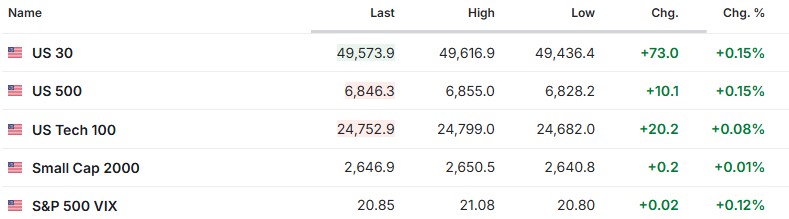
The futures look slightly positive, but it is still 36 hours until market open because of the holiday.
Fingers crossed for a good week!
Heather
Trade the tide not the waves.
Q & A
Related Posts
- Side Effects of AI
Unintended Consequences of AI. There’s a side effect of the ‘AI Revolution’ that I’ve been…
- NVIDIA & AI
NVIDIA & AI. NVIDIA dominated the market news this week, with its results being reported…
- AI: Hype & Bubble?
AI: Is it all Hype & Bubble? The market went down last week (until Friday),…























17 Responses
Hello – I’m a single woman looking to build my own empire and I’m hoping ITM will guide me into doing so. 🙂
Hi Kristen – lovely to hear from you, and every best wish for your empire!
You need a dream and goals – I am afraid that I set mine too low when I was young. I just wanted to have ‘F.U.’ money so that I had control over my time and wouldn’t need to kowtow to a boss. You would laugh at some of the things I tried: writing Mills & Boons, designing mohair, etc. The first one that worked was prpoerty – but I was lucky, at the right place at the right time, won’t work now.
I didn’t think anything more was possible – but I should have set my sights much higher much earlier!
So well done and the very best of luck
x
h
Is this spy option system still useadle and successful give the high level of th SP . The options are so high. Thank you for answering. Your “Bull” is fantastic.
HI Ron – yes the SPY signals still hold, and I realize the options are high – so SPYG is an alternative.
WE are in a period of consolidation, and the signals don’t work so well when the 2 SMAs are travelling in parallel – which is where we seem to be getting to. That means it doesn’t take much for the OUT signal to be triggered – but it also means we may be acting on a false signal and have ti buy in again if there is a golden cross.
Nothing is perfect – but ITM is the nearest I have found.
And thatnk you for your kind words.
x
h
Hi Heather, greetings from Canada! I’m joining the chorus of praise for your books. Thank you!
A question about the new trading pattern of ITM QQQ before its publication. Does this apply to the ETF itself, too? When the death cross occurs between the 10-day and 100-day SMAs, should we consider liquidating the ETF holdings (not only options) to preserve capital? Despite the 10% capital gain of the current market conditions?
Thank you so much for your research and insights!
Joe
HI Joe – thank you! And hi to anotehr colony!
The death cross isn’t exactly the 10/200 cross – but that is vlose enough.
I can’t advise you what to do, but I have exited all my QQQ options. My straight QQQ shares – I haven’t dumped them yet, but on a watch – any dip and I’m out. I should probably have got out – but the chart is still showing consolidation so waiting for a definitive move.
So – just so I am clear – am out of all QQQ options, preparing to exit shares also if drops out of darvas box.
And – just remember- I am not a financial adviser, ca just tell you what I am doing based on research.
Hope this helps – and all will be explained in the new book!
Thanks!
h
Hello Heather. I want to thank you for your books and your blog and your wisdom. You have definitely changed my life and my knowledge of the stock market. One thing I did miss though is the 100 SMA for QQQ. I know you’ve been talking about it in the blog and it will be featured in your new book, but I did not get out last Thursday because I was looking at the 200 SMA. Is it too late? I rolled the contracts about a week ago so I will take a loss if I bail right now. That makes me think I should wait it out. Again thank you for everything you do.
Andy
HI Andy
How lovely of you to say that! Has quite made my day!
Right now the sell signal for QQQ is in force so the strategy suggests that you get out. It is probably better getting out now as it has gone up slightly – but the cross has been confirmed.
Hope this helps
h
Heather,
I can’t wait for the new book release and learn more about your trading signals for QQQ. Over the years I have grown to rely on the 10/200 SMA signals for SPY, and even applied them to QQQ all with great success. The idea of fine tuning signals for QQQ is exciting. Thank you for all you do to make this an amazing blog!!
HI David – yes I’ve been using ITM on QQQ also – and it has been ood because it has mainly been in a bull market. In previous books I mentioned that I traded t, but didn’t specifically recoment=d that anyone used ITM on it until it was exhaustively backtested – and on backtesting I find that there is a set of parameters that works really well.
I don’t really want to preempt the book, simply because people will be asking about it and I will feel obliged to reply, when all the answers will be in the book and the website that I am creating to go with it.
All will be revealed soon!
(but yes the QQQ sell has definitely been triggered and I’m out)
h
Thanks much for all the research that went into this week’s blog. That must have taken a lot of time.
And I too am glad your new book is nearing availability.
Thank you Jay! I’m going dross eyed from proofing the eBook, wiaint on the paperback and hardback to arrive – shouldn’t be too much longer.
x
h
Do you have any predictions when the market might have 10/200 sma crossover?
HI Michael – I don’t predict just describe what I see – and at the moment it is going sideways – consolidating.
My feeling is that it will eventually break out to the upside – but that is just a feeling, and I’m the eternal optimist so I wouldn’t put too much faith in my feelings!
Just watch for the signals.
hope this helps
h
Is this spy option system still useadle and successful give the high level of th SP . The options are so high. Thank you for answering. Your “Bull” is fantastic.
Ron
Thanks always Heather ! Can’t wait for the new book, especially seeing as a “buy signal” may be in our near future ! (QQQ)
HI JOseph – well there has definitely been a sell signal, but I don’t feel at all convinced that it isn’t going to be a false alarm – so hopefully there will be a buy signal soon!
x
h