


Predicting Pullbacks
Everyone tries to guess the next pullback in the market – unless of course we are free-falling into a bear market!

Then, traders are looking for the bounce – which often turns out to be of the dead cat variety.
When they finally throw in the towel and stand back in despair – capitulation – usually a sign we’re getting near the bottom.
Why do we do it?
The funny thing is that although traders eventually give up looking for a bounce in a bear market, they never give up looking for a drop in a bull market. I’ve got a theory: our brains are just wired wrong. It’s called loss aversion – the core finding of Prospect Theory is that we feel the pain of losses roughly twice as much as we feel the joy of equivalent gains. We are biologically wired to fear the loss more than we desire the gain, making us permanently alert for the next danger.

Pullback Frequency
Historically, pullbacks are not rare events – they are the market’s normal operating rhythm.
- 3% pullback: multiple times most years.
- 5% pullback: ~2–3 times per year on average.
- 10% correction: roughly every 1–2 years.
- Years with no 10% correction are the exception, not the rule.
Timing of Pullbacks
It isn’t what we want to hear – but here’s the inconvenient truth – and this is a cold, statistical point, not a personal opinion – nothing reliably predicts the start of a pullback.
- The usual suspects are useless: RSI “overbought” levels do not call tops.
- Elevated sentiment doesn’t consistently mark reversals; happy traders can stay happy for a long time.
- Extensions above moving averages are not timing tools. They only show you what has already happened.
- The market often rises on no news… and falls on no news.

The next 3%, 5%, or 10% drop is unpredictable because it is inherently random.
But that inconvenient reality never stops traders burning an enormous amount of emotional energy trying to outsmart something that has no predictive structure whatsoever.
Hindsight Never Fails
The chart makes past tops look crystal clear: the double-top, the wick, the rollover, the MACD turn. But in real time:
- Most early-stage reversals look identical to normal, everyday noise.
- Half the “obvious tops” chicken out, resolve upward and become tedious continuation patterns.
- Indicators don’t lead, they lag. By the time they finally get around to confirming a pullback, much of the move is already over.

Hindsight – beloved of many market gurus, the basis of half the books on your shelf – creates a glorious, but utterly fake, illusion of predictability. The live market, meanwhile, is happy to eat your lunch.
How ITM handles pullbacks
ITM has rules. Simple. We don’t flinch at market noise. We ignore the waves and ride the tide. ITM rules dictate when we exit, not some fleeting market panic.
Pullbacks are a fact of life for traders, and if you can’t meet one without having a meltdown then perhaps trading isn’t your game. Once you accept them as part of the landscape, normal, expected, totally irrelevant to your decision – you’ll be able to sleep easier at night! Successful trading isn’t about predicting pullbacks – it’s about surviving them without doing something stupid.
The stock market is a device for transferring money from the impatient to the patient.
Warren Buffett
The stock market is the only market where things go on sale and all the customers run out of the store.
Cullen Roche
More money has been lost trying to anticipate and protect from corrections than actually in them.
Peter Lynch
To the markets . .
Friday delivered an unpleasant surprise -and that was after an interest rate cut! It makes you wonder what would have happened if the Fed hadn’t cut. Markets can rise on bad news and fall on good news. The market does what the market does.
Semiconductor Stocks
Broadcom was the culprit; it was sold off after it warned that while revenue is growing, a larger share is coming from lower-margin products (notably AI infrastructure and custom silicon), which compresses gross margins even if total sales rise. That shift in revenue mix is what spooked the market. Here’s what happened:

The chart tells the story clearly. The gap up in September was the last earnings report when it reported better-than-expected revenue and profit, highlighted rapidly growing demand for its AI-focused chips, and announced a large new AI infrastructure deal (reported at over $10 billion). The gap down on Friday was investors fretting about profitability. You can see that there were a lot of nervous nellies ready to jump – the highest volume of the year.
Why is the Broadcom ticker AVGO? Because Avago Technologies acquired the old Broadcom Corporation in 2016 and took Broadcom’s name, but kept Avago’s existing stock ticker (AVGO).
Why did Broadcom move the market?
Why did Broadcom move the market?
It’s size. It’s enormous. Semiconductor companies are now huge. Here are the top ten by market cap (which fluctuates daily):
- NVIDIA (NVDA) – $4.3 Trillion
- Broadcom (AVGO) – $1.9 Trillion
- Taiwan Semiconductor Manufacturing (TSM) – $1.4 Trillion
- Advanced Micro Devices (AMD) – $400 Billion
- Micron Technology (MU) – $390 Billion
- ASML Holding (ASML) – $370 Billion
- Intel (INTC) – $240 Billion
- Texas Instruments (TXN) – $230 Billion
- Qualcomm (QCOM) – $210 Billion
- Analog Devices (ADI) – $180 Billion
NVIDIA is the largest company by market cap on the NYSE. Broadcom, while not as big as NVIDIA, Apple, Microsoft, Alphabet and Amazon, is in sixth place (and above Meta and Tesla). Hence the outsized market reaction on Friday.
SPY Charts
Although Friday felt bad, it wasn’t actually anything really awful. 680 seems to be acting as support since late November, and although there was a higher that average volume it wasn’t huge and was to be expected. Whenever there is an intraday pullback everyone piles in, especially before the weekend.

The long term chart shows the pullback.

SPYG Charts
SPYG suffered more than SPY, mainly due to its higher preponderance of tech stocks – more of that in the QQQ section.

The long term chart is back to the lower bound.

QQQ Charts
QQQ was hurt much worse than SPY – a much bigger red candle and also on high volume. Thanks Broadcom!
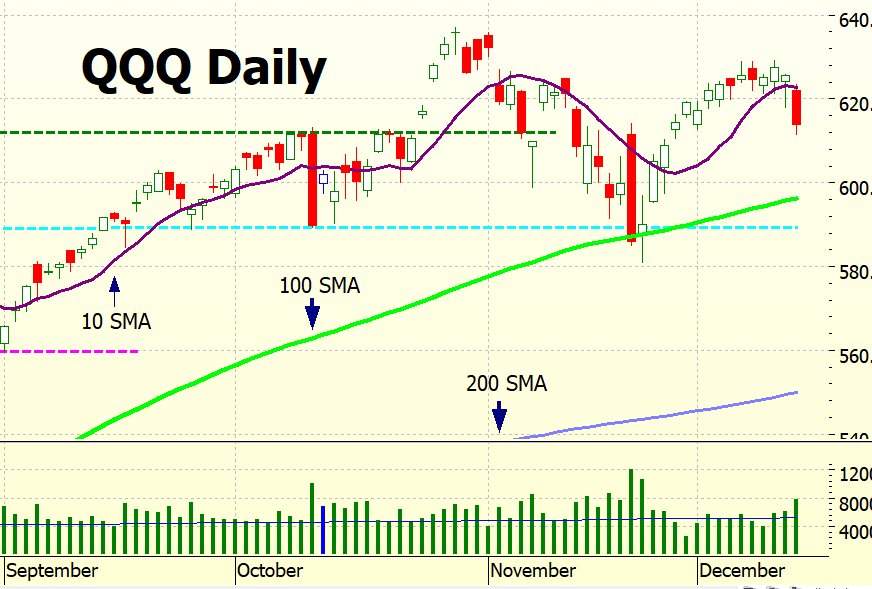
On the long term chart its still in the middle of the trading channel.

Vix Chart (Volatility)
The Vix was not much affected:

ITMeter

The week ahead . . .
Well, no major earnings are scheduled, so that’s one thing we don’t have to worry about! Neither do we have to worry about the Fed, but there are scheduled macroeconomic announcements:
- Tuesday 16 Dec:S. Nonfarm Payrolls for November, Unemployment Rate, Average Hourly Earnings
- Wednesday 17 Dec: Retail Sales (October).
- Thursday 18 Dec: Consumer Price Index (CPI) – headline and core for November, and Weekly Jobless Claims.
- Friday 19 Dec: Personal Income & Personal Spending (October) and PCE Price Index (headline and core), Existing Home Sales, University of Michigan Consumer Sentiment & Inflation Expectations.
So that should be enough to keep investors fussing and fretting. (But not us. The ITM OUT signal is nowhere near)
The futures
Slightly up – to be expected when traders realise that they probably overreacted on Friday.

Australia – ‘Poor Fellow, My Country’
You have probably seen news of the horrible massacre at Bondi Beach, one of Australia’s icons. The anger here is palpable: the government was warned repeatedly that this would happen, yet it did nothing and now more than 15 people (including a 10 year old girl) are dead, many more wounded.
I can’t sign off as I usually do when many people have the worst week of their lives ahead. It is the saddest day.

Heather
Trade the tide, not the waves
Q & A
Related Posts
- ITM Update: Predicting the Future
ITM Update: Predicting the Future In last weekend’s post I said ‘don’t be surprised if…
























11 Responses
My personal return for year to date of 2025 is 22% so far. Thank you Heather Cullen and her ITM Method for helping me achieving my financial independence.
Great George Henry – glad you are happy!.
Have a wonderful Christmas!
x
h
Random acts of violence. I don’t watch the news or nature programs… since being in the USA the two political parties have shown that we’re evolving into apes and Mother Nature can be very cruel being part of the eat or be eaten scenario. My usual market humor I’ll save for another day.
R
Hey Randy – I am afraid I am glued to the news channels, hoping against hope that our completely gormless PM will grow a spine and resign.
Alas, I think it is a very unrealistic hope.
I guess I shouldn’t have said this – am trying to keep ITM Blog free of political comment – but this is beyond the pale.
x
h
Hi Heather,
There is talk of wall street petitioning for trading 24/7. If this is going to happen what effect might this have on ITM, if any?
Thanks for your time.
Kevin
Hi Kevin- see previous reply – will research and do on next blog.
h
Hi Heather,
Have you read the yahoo article about Wall St. ? “NEW YORK, Dec 15 (Reuters) – Nasdaq, one of the world’s largest exchanges that is home to tech companies Nvidia (NVDA), Apple (AAPL) and Amazon (AMZN), is planning to submit paperwork with the U.S. Securities and Exchange Commission on Monday to roll out round-the-clock trading of stocks, as it looks to capitalize on a global demand for U.S. equities.”
Do you think 24/7 trading will help the ITM traders or hurt them, or perhaps have no effect on them at all?
I’d be interested in what you have to say about it.
Thanks for your time.
Kevin
Hi Kevin – my initial reaction was ‘hooray – I don’t have to stay awake at night any more’ – but then commonsense kicked in.
So – I don’t think it will make any doifference at all toITM – bit I am going to do some research and do the next blog on it.
Part of me thinks – what took them so long??
h
Dear Heather,
I am so sorry to hear the news about the Bondi Beach incident. Please be safe and watch for our surroundings and be respectful and responsible. I think our governments need to provide a safe environment to the people. Learn from El Salvador and Singapore in terms of safety for example.
Hi Heather, Thanks for writing the book, just finished reading ITM Bull Market and enjoyed reading it. Question I have is regarding SPYG, it does not have lot of option volume, has it changed since you wrote the book? Have you or your students successfully ran this strategy with it? BTW, if you have a place to have discussions like this on your website, that would very helpful. Thanks Rajeev
Hi Heather, sorry to bother you, I was trying to pick a 192 days, since is the longest expiry date, SPYG call option. I was aiming at the $65, $70 strike, but then I saw the Volumen/Open Int numbers for the $65 strike as Volume: 7/Open Int: 48 and for the $70 strike Volume: 1/Open Int: 2 and started doubting if those Volume/Open Int numbers represent some issue, basically if I will have issues selling the contract later on. I revisited your book and from what I understood it says that it does not matter the number for Volume/Open Int, but cannot really wrap my head around why if the low numbers are not a problem. I understand that whatever you say is not a financial advise and at the end whatever I do is my own decision, so I wanted to see if you could maybe guide me a little bit on why the low Volume/Open Int may not be a problem. I have read the book two times and I thought I had everything figured out for trying to get my first ITMS contract, but seems it was not quite so :). I apologize for disturbing you and thanks in advance for your time.
Alejandro