


AI Disruption & War.
This market is getting more and more frustrating. AI is going to transform everything – business, education, society – and instead of working out how we are going to use it to improve our lives we are busy chasing our tails and wringing our hands. (Can you do both at once? Because that feels like what is happening.)
Same old same old
Every major technological shift has looked confusing and contradictory while it was happening. We tend to imagine progress as a steady climb, but it’s more like a flight of stairs – a series of disruptions that render the “old way” of doing business expensive, slow, and eventually obsolete. History suggests this frantic hand-wringing is a standard symptom of a big step in progress. And there have been many.
The Great Horse Manure Crisis
In 1894, urban planners in New York were paralyzed. The math was simple: more people meant more horses (150,000 and rising) producing 3.5 million pounds of waste every day.
That’s 20 * 40 ft shipping containers – 365 days a year!


Which meant that within 50 years, the streets would be nine feet deep in manure. They held international conferences. They looked for better shovels. They wrung their hands and chased their tails, obsessed with the “manure problem.”
The Model T Ford
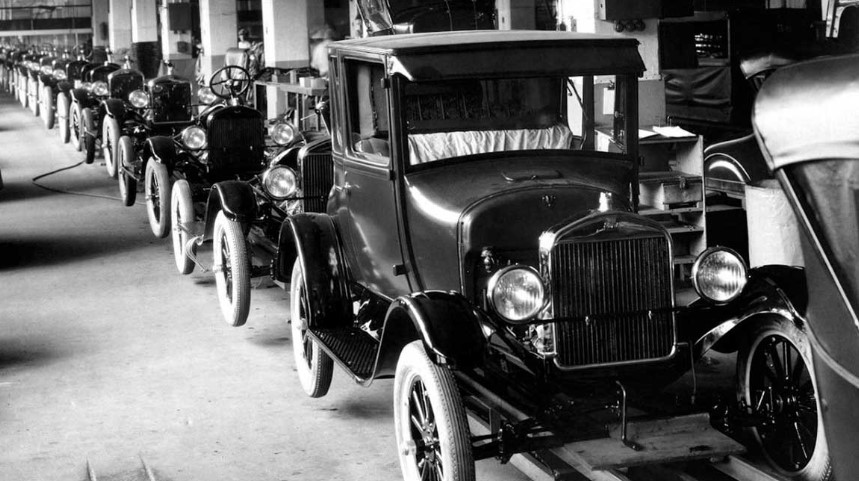
Then the Model T arrived in 1908. The “unsolvable” manure problem didn’t get solved – it just wasn’t a problem anymore. The disruption didn’t come from a better way to manage horses; it gave us a different world where the original problem simply ceased to exist
The Digital Dung Crisis
Today, we are doing the exact same thing with AI. We are obsessed with “fixing” the old systems: how to detect an AI-written essay, how to tax a bot, how to slow the “output” down so we don’t drown in digital slurry, how we can keep people employed when AI can do their job better and quicker.
We are looking for better shovels when the “horse” of traditional workflow is being sent to the glue factory. We’re so busy wringing our hands over the mess that we’re missing the fact that it is being replaced entirely.
The blindness of experts
History shows that even the experts are usually blind to the scale of the change. In 1953, IBM’s Thomas Watson Jr. expected a market for maybe five of their massive 701 “defense calculators.” He came home with orders for 18. The demand was over 300% higher because he was looking at a transformational tool through the lens of the existing world.

PCs too
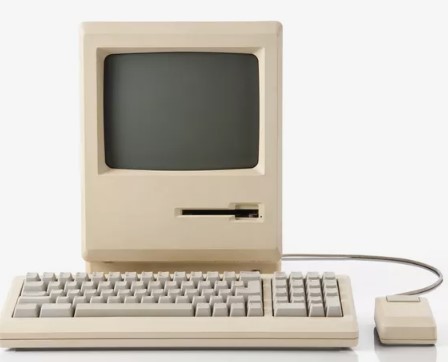
We saw it again with the Personal Computer. In the 70s, it was a “hobbyist’s toy.” Within a decade, it had largely eliminated the typewriter and adding-machine industries and made typing pools and filing departments obsolete.
The Internet
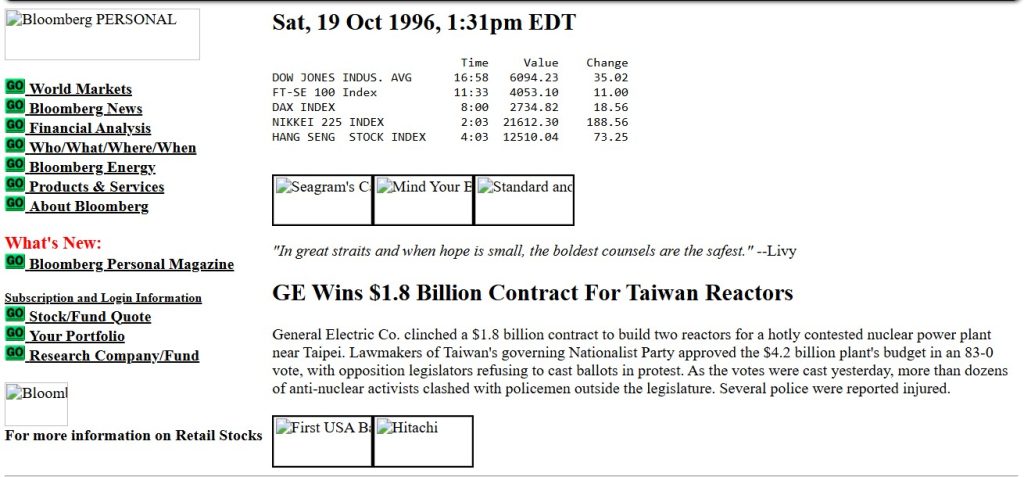
In the early 1990s it was widely dismissed as a niche academic network with limited commercial use. Almost overnight, it became the backbone of global commerce, although the websites from that era look comical to us today.

Newspapers lost classified advertising. Travel agents disappeared. Retail moved online. Entire industries that had seemed permanent turned out to be transitional. If you weren’t online, you ceased to exist.
Agentic AI
Now we are standing on another step in the staircase: Agentic AI. This isn’t just a faster Google Search or a better spellchecker. It is a shift from a tool that responds to a system that acts.
The market is currently paralyzed by the scale of this shift, wringing its hands over the digital dung. But the lesson from the Model T and the IBM 701 is clear: the technology doesn’t ask for permission, and it certainly doesn’t wait for us to finish our tail-chasing before it rewrites the rules of the game.
AI: Instruction to Delegation
If standard AI is a tool you use to write a letter, Agentic AI is the assistant that writes the letter, hires the courier, and confirms the delivery without you having to touch the keyboard. It’s the move from Instruction to Delegation. Instead of being handed a hammer you are hiring a carpenter.
Block lays Off 4,000 employees
The news this week has been the Nvidia earnings and Block (parent of Afterpay) laying off 40% of its workforce (4,000 employees). It is worth reading what Dorsey (Head & cofounder) said:
“The core thesis is simple,” wrote Dorsey. “Intelligence tools have changed what it means to build and run a company.” In December last year he realized how capable and intelligent AI models had become: “If there are any gaps in our usage of AI right now, it’s an application gap,” he said.
Other companies laying off workers are:
- Salesforce: 4,000
- Pinterest: 15%
- Amazon: 14,000
- UPS: 14,000
- Target: 1,800
NVDA Earnings
Nvidia didn’t just meet expectations this week – they sprinted past them on every metric.
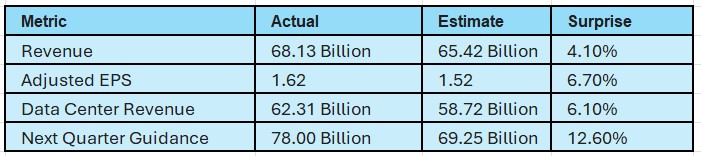
And so the stock rose big time? Smashed upwards? Yes? Actually, no. Despite crushing estimates, NVDA rose a measured +1.5% to +2.2% in after-hours trading. And then crashed:
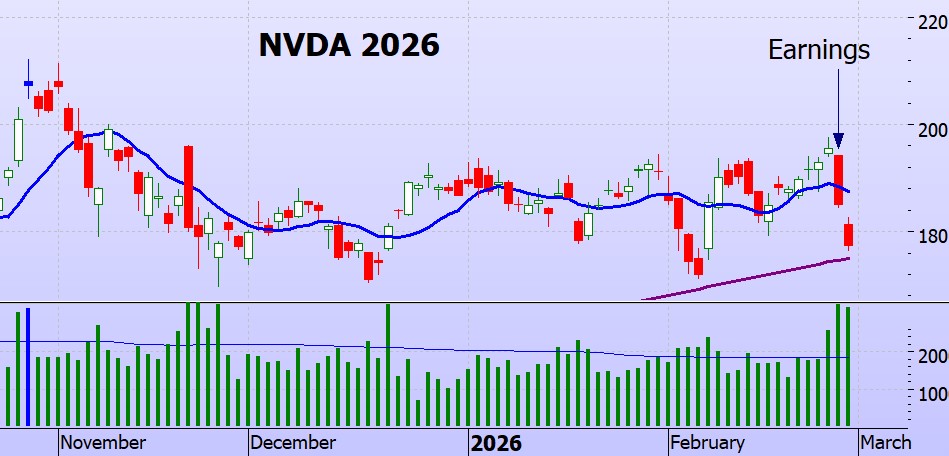
You really wonder what you have to do to please this market! Exceptional results produce a 10% drop – a reminder that markets struggle to price transformational change while it is happening.
The NVDA Strangle
Just for fun I priced putting a strangle on NVIDIA the day before earnings. A strangle is buying a call and put simultaneously, and in this case 3 days to expiration. (BTW, this is NOT recommended – for interest only).
I figured after all I had read that the earnings were going to be good – but I also knew that if they disappointed it would crash so a strangle should cover both scenarios. The calcs are in the table below, but the summary is NVDA was $192.92 so choosing up and down $7.50:
- Put strike 185 ($2.90)
- Call strike 200 ($2.87)
- Cost of strangle: $577
- Breakeven points: $179.23 on the downside and $205.77 on the upside.
- To double: $167.69 low, 217.31 high.
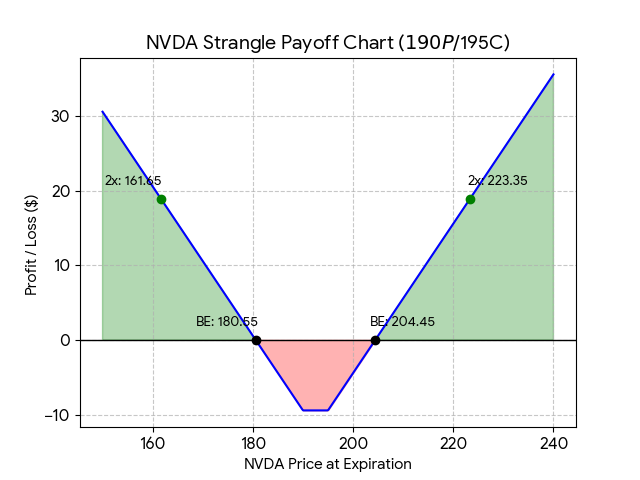
In other words to double my money NVDA would have to drop or rise 13%. And surprise – it dropped to just past breakeven at close Friday ($177.19), so I would have made a small profit. I didn’t do the trade, just checked it out. Who would have thunk?

The AI Paradox
Nvidia is projecting nearly $9 billion more in revenue next quarter than the experts expected. They aren’t just selling chips; they are building the engine for an autonomous economy. But the market is currently paralyzed by the scale of this shift, wringing its hands over the digital dung. But the technology doesn’t wait for us to finish our tail-chasing before it rewrites the rules of the game.

ITM Actions
So what do we do? Well, ITM has lived through the crises before, and the backtesting takes all of them into account. The ITM current status is:
- SPY: stay in, watch and wait.
- SPYG: stay in, watch and wait.
- QQQ: stay out, watch and wait.
If the signals happen between blogs I will send out a special email. Until then we continue frustrated but safe.
To the markets . . .
The Citrini report certainly put the cat among the pigeons last week. When I started reading it, it seemed more like a futuristic novel – and strangely I was reading Lionel Shriver’s ‘Mania’ (BTW highly recommended) at the same time. It was most unlike any other financial report I had ever read – why don’t you have a look for yourselves? Here’s the link: https://www.citriniresearch.com/p/2028gic
SPY Charts
Another nothing week. Still consolidating within the Darvas box.
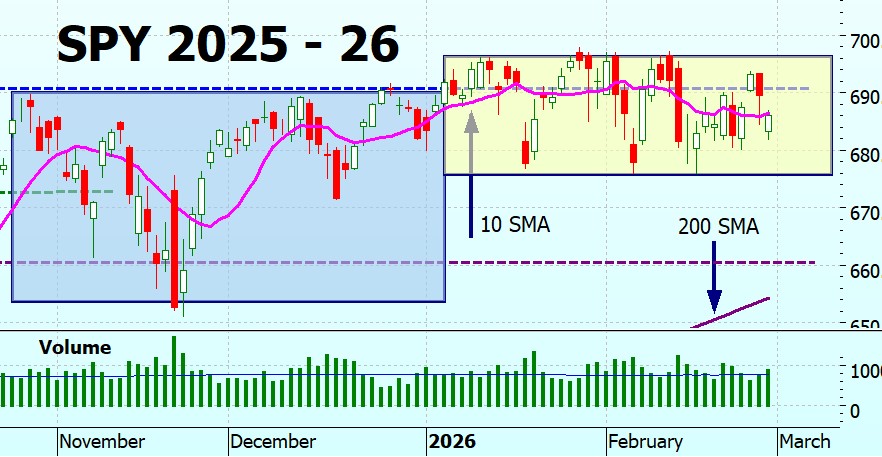
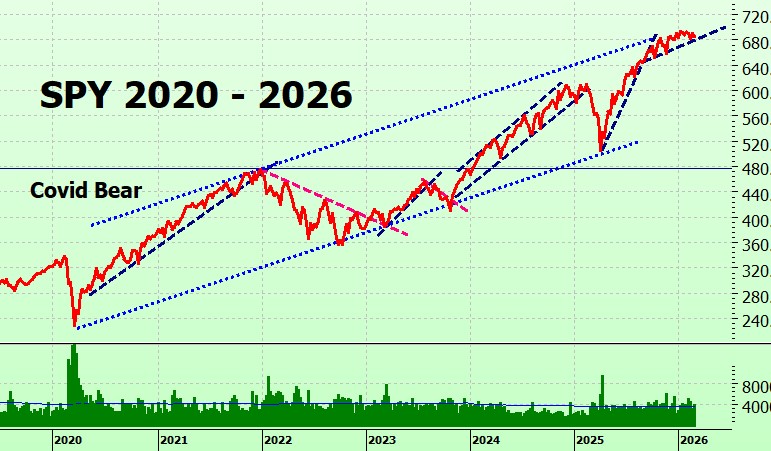
The long term chart the new uptrend seems to be holding.
SPYG Charts
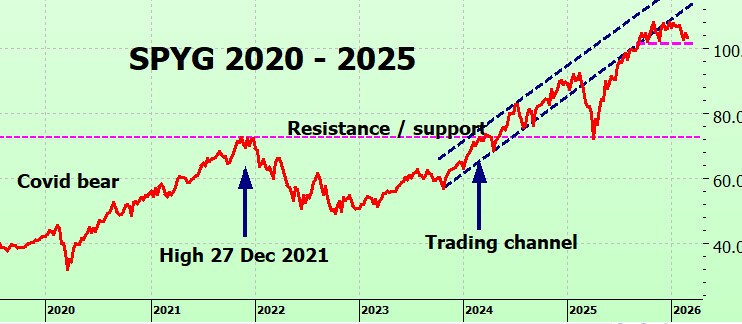
SPYG just as uninspiring. Inside the same Darvas box for almost 5 months.
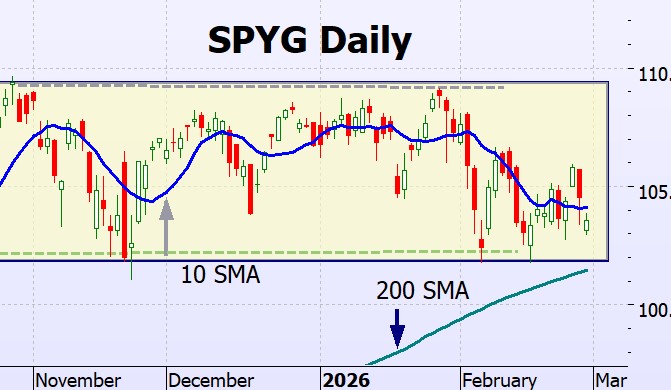
On the long term chart, the new support line (pink) seems to be holding.
QQQ Charts
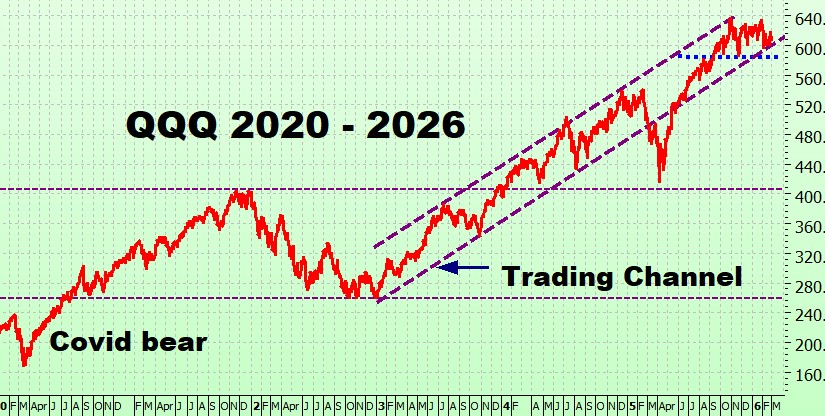
As for SPYG, QQQ is still consolidating in its Darvas box – where is has been for 5 months.

On the long term chart , the new support line (blue) seems to be holding.
VIX Charts (Volatility)
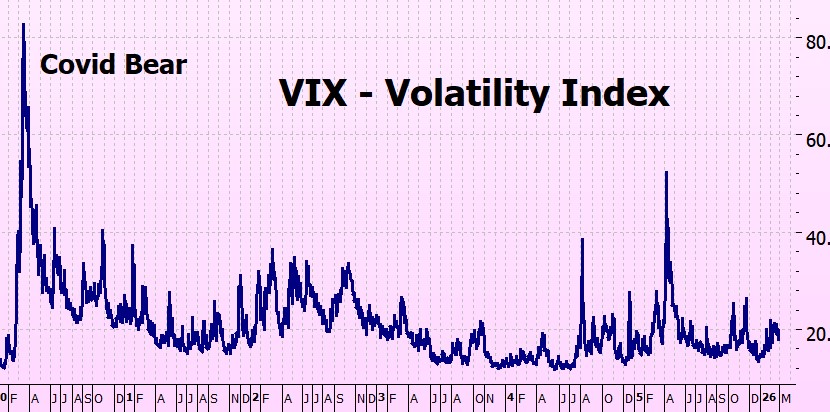
Still in low volatility territory.
ITMeter
SPY / SPYG

QQQ

The week ahead . . .
The attack on Iran has been the major news. Not unexpected – there was plenty of warning. Let’s cast our minds back 23 years – the US invaded Iraq. What effect did that have on the stock market?

The start of a five-year bull market. Is it directly comparable? I don’t know, but it is always interesting making historical comparisons. So, let’s look at what is happening now. The headlines are bad (as you would expect)

But when you look at the actual figures . . .
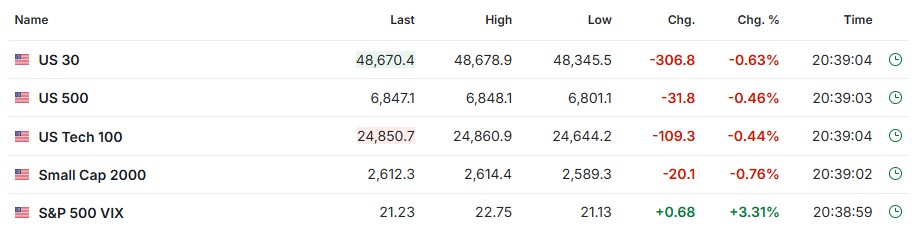
Not quite so dire. However, it is 12 hours to market open – and for what it is worth I don’t think it will be that bad. Markets hate uncertainty – ‘buy on rumour sell on fact’ – in this case I think it will be the other way around. Let’s hope so anyway.
Fingers crossed for a good week!
Heather
Trade the tide – not the waves
Q & A
Related Posts
- The AI Hype Cycle
Where is AI on the Hype Cycle? Many of you will know about the Hype…
- The Duck Market
The Duck Market. While the major indexes have been drifting sideways since October, don't let…
- Bear Trap?
Bear Traps and Log Charts Well, I must remember not to go away again –…
























10 Responses
Hi Heather,
An insightful and thought provoking post, and a scenario my artist wife finds depressing…
Re ITM, are you trading the SPY on a daily or weekly chart?
Looking forward to your new book too, so please keep up the good work!
Hi Richard,
glad you found it interesting. Naturally, as traders, we want everything to be calm and ordered – but unfortunately life isn’t like that.
Your wife has plenty of company – many people hate where this seems to be going. On the other hand I find it all tremendously exciting, the future is coming whether we like it or not so we might as well like it!
Re charts – always the daily chart for ITM signals. The weekly is useful for a long term perspective but not what we base our traing on.
Hope this helps
h
Thanks for the chart clarification Heather, appreciated. Re AI, I’m well onboard but my wife has a love/hate relationship with it. Oh well… !
Cheers,
Richard.
It took forever (or seemed like it) to read the research article. It was amazingly detailed and scary (and made me glad I’m retired). I fed it to Gemini and asked for a rating on each S&P sector’s investibility if it is accurate. The result:
S&P Sector In-Depth Review & Investability Grades
Based on the “GIC” scenario (1 = Avoid/Sell, 10 = Strong Buy/Overweight)
1. Information Technology (Software & Services Focus)
• Grade: 3/10
• Analysis: While “Magnificent 7” hardware plays might thrive early, the GIC predicts a “race to the bottom” for SaaS. When AI can write, deploy, and maintain custom code for pennies, the “moat” of proprietary software evaporates. Differentiation collapses, and legacy seats-based pricing models fail as human headcount drops.
2. Financials
• Grade: 2/10
• Analysis: This is the epicenter of the crisis. Agent-to-agent commerce bypasses traditional payment rails (Visa/Mastercard) in favor of low-fee stablecoins or direct clearing. Furthermore, mass white-collar layoffs trigger a systemic mortgage and private credit crisis that banks are ill-equipped to handle.
3. Energy
• Grade: 10/10
• Analysis: In the GIC scenario, energy is the ultimate currency. AI compute demand is insatiable. Whether the economy is booming or collapsing into “surveillance and drone” states, the need for nuclear, natural gas, and grid infrastructure is the only constant. It is the “hard floor” of the economy.
4. Utilities
• Grade: 9/10
• Analysis: Similar to energy, utilities transition from “boring income plays” to “strategic bottlenecks.” Companies with power generation assets and grid-connection rights hold the keys to the data centers that power the new world.
5. Real Estate (Office & Residential Focus)
• Grade: 2/10
• Analysis: Commercial office space becomes permanently obsolete. More critically, high-end residential real estate faces a “valuation cliff” as the high-earning white-collar professionals (the primary buyers) lose their income streams to AI agents.
6. Consumer Discretionary
• Grade: 1/10
• Analysis: As labor’s share of GDP drops from 56% to 46%, discretionary spending is the first to vanish. Delivery platforms (DoorDash/Uber) and luxury brands face a “demand desert” when the middle class is replaced by agents that don’t eat, travel, or seek status.
7. Consumer Staples
• Grade: 6/10
• Analysis: A defensive “survival” play. While people stop buying iPhones, they still need calories. However, margins are pressured by the overall deflationary environment and the loss of brand loyalty as AI agents shop purely on price/utility.
8. Industrials (Robotics & Defense Focus)
• Grade: 8/10
• Analysis: As we move from “Bits to Atoms,” companies that build the physical infrastructure—robots, drones, and autonomous systems—become essential. In a crisis, the government shifts spending toward AI-driven defense and domestic automation.
9. Health Care
• Grade: 7/10
• Analysis: Aging demographics remain a reality regardless of AI. While AI will deflate the cost of drug discovery (hurting some legacy Pharma margins), the “delivery” of care remains a physical necessity that is harder to automate than a spreadsheet.
10. Communication Services
• Grade: 4/10
• Analysis: Ad-supported models (Google/Meta) struggle when human attention is no longer the primary driver of commerce. If agents are buying products based on technical specs, the multi-billion dollar “digital ad” industry loses its efficacy.
11. Materials
• Grade: 8/10
• Analysis: Copper, lithium, and rare earth metals are the “blood” of the hardware-centric economy. You cannot build a “post-labor” world without massive physical expansion of the electrical and compute grid.
Analyst Final Take:
If the Citrini scenario plays out, the traditional “60/40” portfolio is dead. Alpha moves from “Platforms” to “Power.” Investors should rotate out of “Process-based” businesses (Financials/SaaS) and into “Resource-based” businesses (Energy/Materials/Hard Tech).
Hi Robert – really iteresting – I never thought of doing that.
Certainly is food for thought.
Certainly the energy aspect is interesting . . . may check it out.
Thank you!
h
Just a quick note of thanks for your great work Heather!
Great article, Heather. All good insights, and thank you for the reminder of what the Market did in 2003. I was thinking that we were going to see a major gap down, and sell off. I have learned to trust the ITM money program and am standing strong for now on SPY and on the sidelines with my QQQ positions. Any updates on book release you are willing share with this audience? I check Amazon every week hoping it’s out.
Thank you for all you do in sharing valuable market information.
HI David – I must say when I saw the futures go down a couple of hours before open, I had a twinge of doubt – but it worked out as I expected.
The panic merchants dumped and fled – then the cooler heads stepped in.
Looking at the charts now – nice green candles, on above average volume. Good. Still in their Darvas boxes, boring. But to be expected.
Re the new book – I am going through the proofs now with a fine tooth comb – I know any mistakes will be found by my eagle-eyed readers – so I am trying to make it as perfect as possible. A couple of weeks, as I have to get all the companion stuff on the website – but I will announce it in the blog, and special pricing for blog followers!
x
h
My grandfather had a blacksmith shop in New York City (the Bronx) in the early part of the 20th century. He closed the shop in 1920 . . . more cars, fewer horses.
Cars make horses (and the jobs associated with them) obsolete.
So Citrini Research report . . . . AI makes humans obsolete?
Hi Al – blacksmith – yes, once everywhere, now a niche profession!
Humans obsolete?
I don’t think so. Drudgery becoming obsolete – but I think that’s a good thing. After all, isn’t that what humans have been hoping for from time immemorial?
But we have to figure out how it is going to work – and I don’t think many people are addressing that still stuck in the old paradigm.
But have great faith in humans – we will work it out eventually!
x
h