Sometimes the itch to DO something becomes quite unbearable and you end up doing something stupid.
I am speaking from experience here!
It has happened to me so many times that I now recognise the symptoms and channel the urge into some action that could hurt me a little if it went wrong – but won’t take me out of the game.
Video
Podcast
Monday 11 May
And that happened on Monday. Everything was going well on the ITM trades, I wasn’t going to touch them, but I was antsy.
The itch was there – I decided to scratch it.
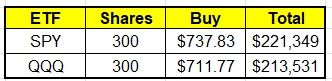
Covered calls would give me some excitement without much risk, so I bought 300 QQQ shares and 300 SPY shares.
That’s a bit hard to read but here is what I bought:
Selling Covered Calls - Expiration
I decided to go 2 days to expiration. Reasoning? Tuesday was too close, Friday too far away, Wednesday was just right. It meant I could buy them back on Wednesday, then sell again with a Friday expiration, get 2 bites at the apple and not hold over the weekend.
Selling to Open (STO) - Strike
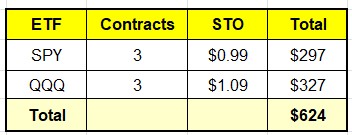
SPY opened at $736.45. I sold 3 $744 calls at $0.99 each ($297)
QQQ opened at 710.36. I sold 3 $724 calls at $1.09 each ($327)
A grand total of just over $600. Was it worth it?? Let’s see.
Wednesday 13 May
On Wednesday, both were trading below the strike:
SPY opened at $738.47.
QQQ opened at $709.96
Excellent – just what I wanted to happen. As they had very little time left on them they were very cheap so rather than waiting for them to expire I decided to buy them back.
Buying Back Covered Calls (BTC)
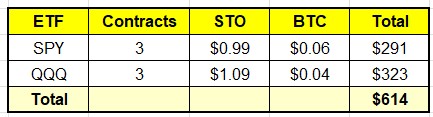
If you STO (Sell To Open) to get out of the trade you must BTC (Buy to Close). So I duly bought back:
BTC SPY $744 C @ $0.06
BTC QQQ $724 C @ $0.04
So it cost $30 to get out of the trade (remember to multiply by 100).
Now let’s see if it was worth it:
Woohoo. Who wouldn’t like $600 for doing (practically) nothing. But, wait, let’s keep it in context.
Percentages tell a different story
To get into the trades cost $434,880, which means the profit % (the only figure that matters) was 614 / 434,880 which works out at 0.14%. Not great. But remember we can do 2 of these per week, or 100 per year which gives us the fantastic annual return of 14%.
Not exactly earth shattering. But let’s try it again.
Still Wednesday 13 May
I’ve lowered my sights a little on the premiums:
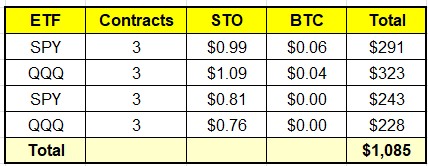
STO SPY $745 C @ $0.81
STO QQQ $724 C @ $0.76
I am looking at those premiums now, and wondering: what was I thinking?? Let’s see how it panned out.
Friday 15th (Buy to Close)
Well Friday was not the most pleasant trading day, with falls of over 1% on both SPY and QQQ. Clearly the calls were unlikely to finish ITM, so I didn’t buy them back but let them expire worthless.
So how much did I make? The grand sum of $1,085. Not looking a gift horse in the mouth, but let’s look at the % return: 0.25%. On a yearly basis that’s 12.5%.
Not earth shattering – but I can understand anyone saying ‘well it isn’t too bad – better than a bank’ – but there are, as always, some risks involved.
Covered Calls Risks
Not that you will end up in debt (as the calls are covered) but because you may be giving away all your profits.
We’ll look at that next week when we examine the popular ‘Wheel’ strategy. It sounds good in theory – but does it work in practice?
‘Real’ Money
It is funny how (in my mind at least) premiums are different to other profits. When I make a big profit overnight on ITM calls I am pleased, but I don’t automatically think what I would do with the money. It just gets added to the total in the account.
With premiums, it is quite different. I feel as though I have conjured the money out of thin air, so I am justified in spending it.
And usually do.
Strange how the human mind works. Maybe it is just me?
To the markets . . .
Friday was not very nice – it was also monthly options expiry day which probably had an effect on the volume. It also had most of the down in the last 2 hours – a typical expiry day. Apart from Friday, it was a rather nice week.
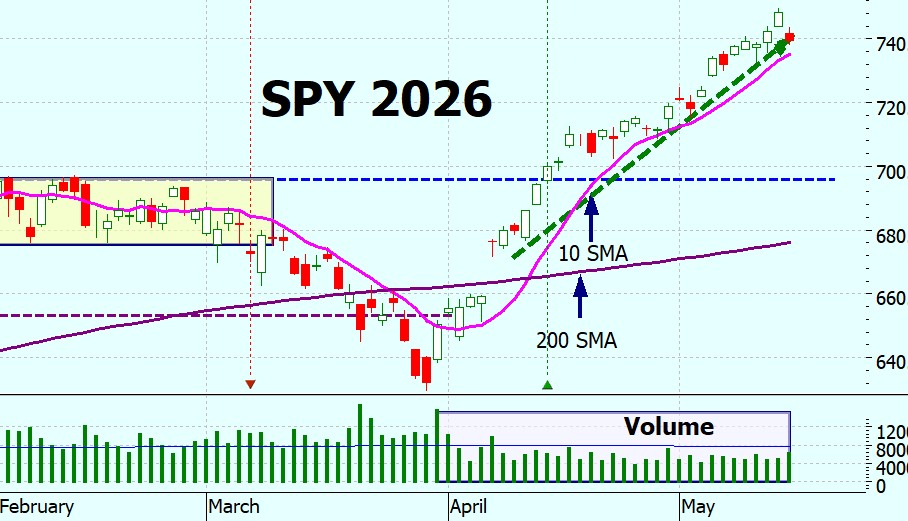
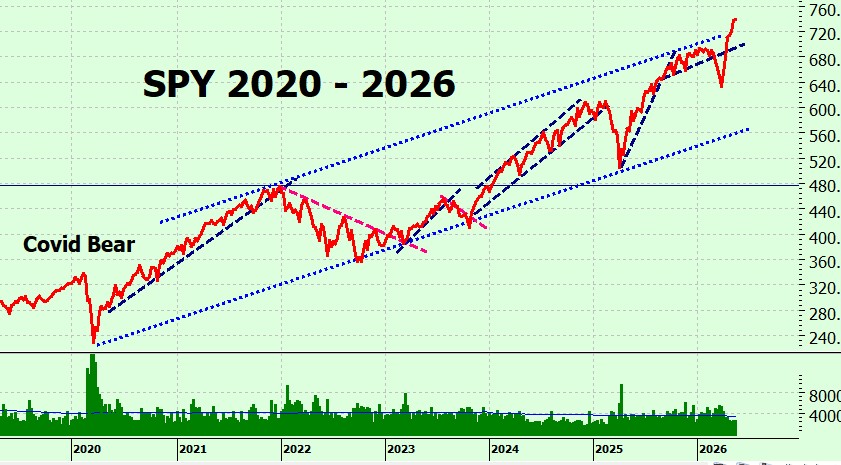
SPY Charts
Although Friday felt like a big down day it wasn’t all that momentous when you look at the chart. SPY is establishing a nice steady uptrend, let’s hope it continues.
Longer term, it has popped right out of the long term trading channel.
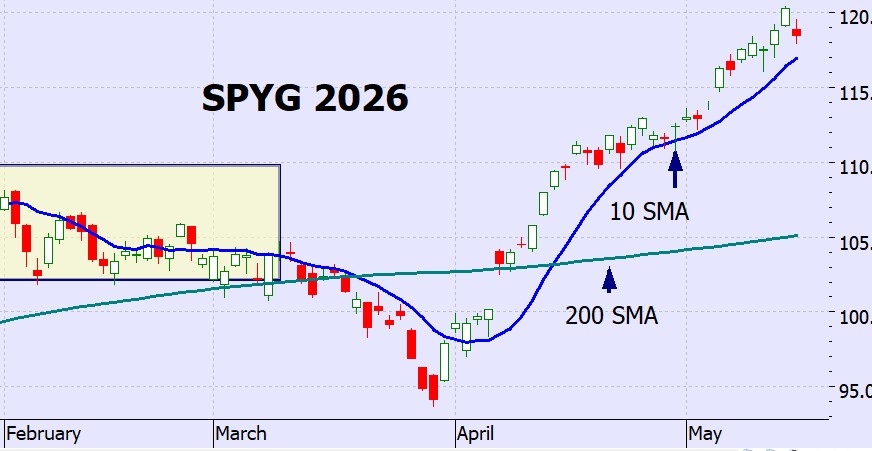
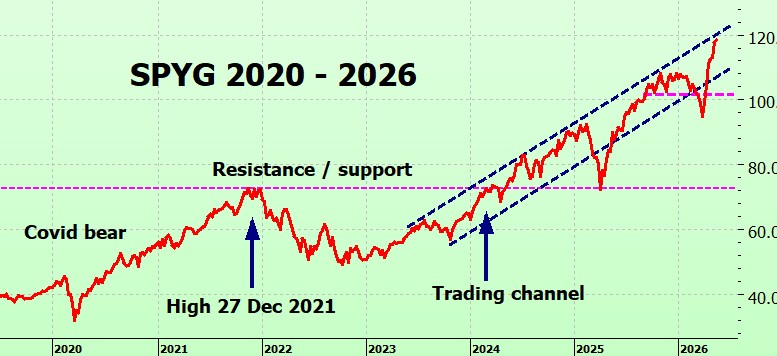
SPYG Charts
SPYG following the pattern of SPY.
Long term it is right at the top of the trading channel.
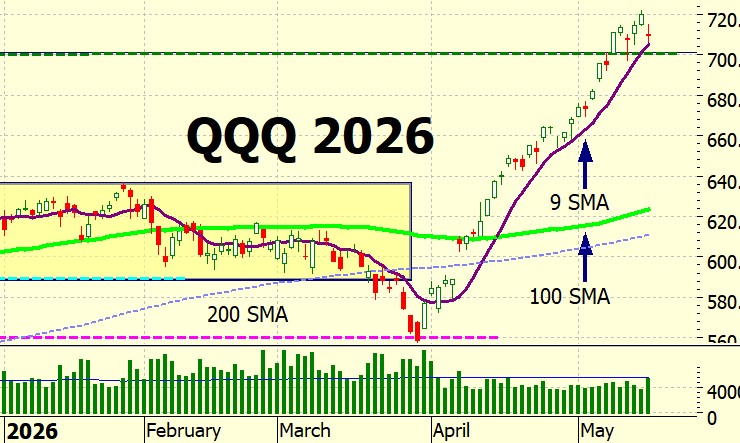
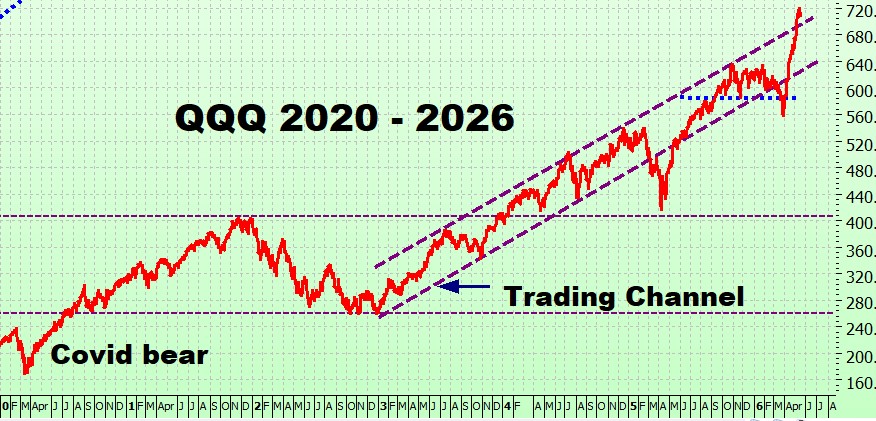
QQQ Charts
It looks like the 700 level may be significant after all – we’ll see this week.
On the long term we are still out of the trading channel, dropping only slightly.
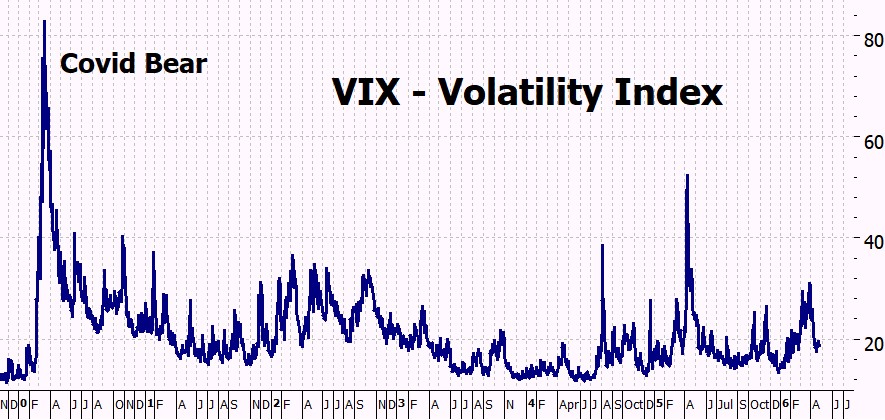
VIX Chart (Volatility)
ITMeter
The week ahead . . .
Likely to be dominated by Nvidia, the continuing AI capex story, and the arrival of new Fed Chair Kevin Warsh. Markets will be watching closely for any shift in tone from the Fed after Jerome Powell’s departure (as chair – he is still sticking around as a governor). Warsh is viewed as more aggressive on balance sheet reduction and potentially more open to rate cuts later in the year.
Thursday – May 21 • Initial Jobless Claims, PMI Manufacturing & Services, Existing Home Sales. • Earnings: Walmart, Deere, Ross Stores, Intuit.
Friday – May 22 • Consumer Sentiment, Leading Economic Indicators. • No major earnings.
Things affecting the market this week: • Nvidia – still the key AI stock. Markets want to see whether AI demand and massive infrastructure spending continue accelerating. • Walmart/Target/Home Depot – important read-through on the health of the U.S. consumer amid higher fuel prices and inflation. • Bond yields and oil prices remain elevated, increasing pressure on rate-sensitive sectors
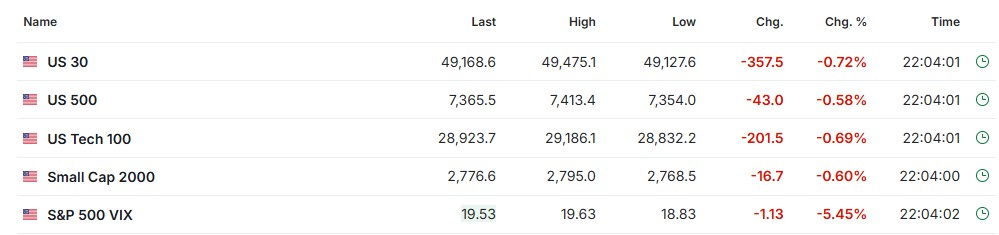
Futures
Not looking great – I think it is probably the news on Iran.
Well, let’s hope we are pleasantly surprised.
Heather
Trade the tide not the waves
Q & A
21 Responses
Hey Heather !
I was wondering if maybe we could explore a blog about higher strike percentages .The gambler in me looks at a win rate of 75% and wonders if just maybe I could chance it ! Say buy ATM and monitor like a hawk! Close out the position and switch back to a 60% strike say after a 10 percent run up in SPY or QQQ . An initial rocket launch so to speak ! I’m finally nearing the end of the new book and will make sure to leave a rave review once finished 🙂
Hey Joe!
The win rate on a higher than 60% started going downhill rapidly. I can’t recall the actual numbers, but they were not good – too easy to crash and burn. OK with a monotonically increasing market – but when do we ever get that?
But that is a great idea for a future blog – I will have to dust off the backtesting (oh, joy) and get some snapshots of different strike levels.
I am very pragmatic – once something works I do it!
If there are any questions abouot strike levels let me know and I wikll try to cover them.
x
h
P.S. and thank you for the offer of a review – it would be much appreciated!
I had the same question, i.e., why not sell short term calls using the d.i.m. calls as the other half of the spread, but you will address this. I sell 14 day bull put spreads on SPX and close with 25-50% profit or at 7 days. Short strike is close to 14 day expected price low. For Americans, SPX has favorable tax treatment and no wash rules. SPX is a European style settled option, thus no early assignment and if assigned it is cash settled. I have never been assigned, I close or roll if the spread is threatened. Lately, I started selling 7 day. Jade Lizard spreads on SPX, a 20 wide strike put spread combined I with a 5 wide bear call spread. The credit must cover the call spread which protects the upside. Profits taken at 25%. Having said all this, I really appreciate your ITM strategy, which is easy to follow and requires little management. Thank you for sharing!
HI Richard
I was just checking my understanding of the Jade Lizard strategy – and saw it described as an ‘iron condor missing one wing’. Made me laugh.
If it is working for you, great – but remember your upside is capped because of the naked short call and your downside will hurt in strong selloffs. I understand that you are going for many small wins, and accept the occasional nasty loss as cost of doing business.
I’m doing this week’s blog on the covered calls idea – see what you think, interested to hear.
x
h
Just one point, the original Jade Lizard sold only the downside put, hence the broken wing condor, but many now replace the put with a bull put spread, making the trade defined risk. Typically, $20 or $30 wide put strikes with a $5 or $10 wide call spread. Clearly, a trade for neutral or mildly bullish market, not for a bearish one. Looking forward to your wheel analysis.
HI Richard – I’ve been going down the rabbit hole on these recent strategies – they weren’t around when I started trading options. Iron condors and butterflies were about as fancy as you got – no lzards or other wildlife!
Which was also quite illuminating (the rabbit hole I mean) so I’m going to do next week’s blog on it.
Let me know what you think – or any suggestions that I should look at.
x
h
Hi Heather,
Speaking of selling covered calls, we can sell cash secured puts as well. Warren Buffett sometimes uses selling cash secured puts. For example, we can sell cash secured puts on TSLL because it is currently at the support level. For $1,400 or $1,500; we can sell At-The-Money on TSLL weekly and receive $50 of premium weekly.
$1,500 receives $50 premium
$15,000 receives $500 premium
$150,000 receives $5,000 premium
Please do your due diligence
Before trading and investing
Hi George Henry
That is a decent rate of return – I will hace a look at it.
Thanks
h
I was contemplating a similar trade today but decided against it.
I was looking at selling Calls expiring 18Jun26 at the expected move but didn’t feel that they were paying enough. Since I think SPY is likely to drop back to the 525 area (middle of Bollinger Band), I’m thinking of selling an ATM for 22May which is around $5.00.
At this time, I’m just trying to follow the ITM SPY program and trade options on other instruments.
Greetings, Heather!
I like your books and blog!
In response to this particular blog, I wonder the following:
Why buy stock to sell Covered Calls when you can sell Covered Calls against the DITM calls you already own? If you aim for just small piles of money selling Calls with far away strikes and/or near-term expirations, wouldn’t that be a worthwhile, easily-managed, extra income-producing strategy?
Stephen
Hi Stpehen – had lots of questions on this blog so have decided to do the next blog answering them. After you read it, if you haven’t had a clear answer please get back to me.
x
h
Well, as I’m sure you know, picking expiration dates only 2 days out drastically reduces the premium you collect and increases the amount of time you would have to spend picking the next 2-day expiration in order to obtain that annual return that you calculated.
I have been selling mostly put options, but also some covered calls for about a year now. I usually pick expirations of about 1 week to 1 month (one of my stocks only supports monthly expiration dates). Almost all of my annual returns, calculated the same way you did, have been well into the double digits with some exceeding 100%. Only one of my puts ended up being assigned to me. A subsequent covered call on it was also assigned and netted me a huge capital gain. (Yes, I do the Wheel strategy.)
I usually sell options that have a delta of about 0.2, so there is (supposedly 🙂 ) only a 1 in 5 chance of it being assigned. If a put is assigned, I purchase the stock for the price that I was willing to pay for it, kind of like a limit order. If a call is assigned, I sell the stock for the price that I was willing to sell it for. Yes I could, and did, miss out on some upside potential, but that would be true of any stock sale that I made.
To be clear, I am aware of the risks, so I only do this with, as they say, “money I can afford to lose”. I don’t really need the extra cash, but it is nice, and gives me something to do in my retirement that is kind of fun and (so far 🙂 ) rewarding.
I enjoy your weekly blogs and am looking forward to next week’s Wheel strategy.
Hey Jimbert! I have just been doing modelling on 1 week to expiration – and will publish the results in next week’s blog. I am postponing the Wheel to the week after!
I think you may be surprised at the frequency of being assigned – I certainly was! – but I have only been testing SPY. PLanning on doing QQQ as well. Golly – all this backtesting is endless . . . !
Curious about the stocks that you use – do you use the stock selection paradigm that hofnsetter (:) uses? And which ones do you regularly use?
Really would be interested in the answer – and I am sure others are too.
x
h
Heather,
As I said, I have only been assigned twice. That was on one put and one call on Broadcom (AVGO). In both cases, it moved unexpectedly fast, much faster than I expected. Other puts have been on AMD, SOFI, Nvidia, Tesla, Amazon, OEF, XLV, HOOD, NBIS, Chevron, so yeah, a mostly tech stocks. I haven’t done as many covered calls, since I was only assigned once on a Broadcom put, but on stocks that I bought outright, I have done them on Nvidia, Palantir, HOOD, SOFI, and LYB. I have been doing monthly for several months, on LYB because it has been sitting at a larger unrealized capital loss than I like and they halved their dividend. So I have been doing covered calls on it with a strike price that would give me a small capital loss that I can live with. Plus it would not be a net loss anymore due to the dividends and covered call premiums that I have received.
How do I pick the stocks to do the options on? Uhm, it’s a little embarrassing, but I watch a couple YouTube channels where sometimes “not a financial advisor” advice is given. I do check the advice to see if fits my risk tolerance. SOFI has been the worst advice. I have a somewhat large unrealized capital loss on it now.
One of the criteria I like is to check the Bollinger bands. I prefer to do puts when a stock is on the low end and calls when on the high end. But I don’t always follow that preference. My main rules are to stick with good companies and low deltas, around 0.2.
Hey Jimbert
fantastic that you are doing so well.
I’m afraid my efforts in that area have not yielded great results for me – I seem to do a lot of work for very little return.
However, I am doing this week’s blog on the practicalities of covered calls – interested to see what you think.
x
h
Heather, since you are already long the call options for the ITM strategy, why not just sell calls against them? If the short calls go in the money, you can roll them out in time. This way you are not putting out additional capital and your percentage returns will be higher based upon the cost of the long options. Just a thought. I have been thinking about doing this but never did. Looking back at the last ITM run up, it would have added up to a lot of additional money.
Hey Anthony – good question – it would definitely increase your percentage return . . . .but it will also increase the profits you give away.
Lots of controversy about this – so I am trying to answer it in next week;s blog.
If that doesn’t answer your question please get back to me.
x
h
Dear Heather,
Some people sell weekly covered calls to get the weekly premium. It is like a job and getting paid weekly salary.
I bought ITM option of SPYG for $4,600 and now it is worth $5,400 which is a profit of $800.
Now let’s say
$46,000 to $54,000
Profit of $8,000
$460,000 to $540,000
Profit of $80,000
I prefer the ITM method
which is less time consuming.
HI George Henry – yues, the ITM method is less fraught and less time consuming. And the thing is – your account grows! So much so that you sometimes look at your overnight profit and think that is more than I used to make a year when I was working!.
ON the other hand sometimes the losses make you go cold – that’s why you have to think in percentages not actual figures.
Next week’s blog is developing the covered call scenario – let me know what you think.
x
h
So technically … you’re buying ( selling to open ) contracts before they expire. My question is if nobody buys these contracts somebody must scoop them up to make them worthless by taking them all before they expire worthless…? For example …somebody opened the contract for say 1000.00 since the person didn’t do anything with it – at the expiring week there’s residual money still in it and if nobody takes the remaining 25.00 of it expires worthless ( or does a the company who wrote it take it )?
R
No — nobody has to “take them” for them to expire worthless. That’s the key point.
An option contract is simply an agreement between a buyer and a seller. If the option finishes out of the money at expiration, it has no intrinsic value, so it simply ceases to exist. Nobody collects the “leftover” value because there isn’t any left at expiry.
What confuses people is that the option may still have some market value before expiry — say $25. That value is mostly time value. If there are still a few days or hours remaining, traders may still pay something for the chance that the option could move ITM before expiration.
But as the clock runs down, that time value decays toward zero. If expiration arrives and the option is still OTM, the holder simply lets it expire. The seller keeps the original premium received when the contract was sold.
So in your example:
• Buyer pays $1,000 for the call.
• Seller receives $1,000.
• Time passes and the option loses value.
• Near expiry it might trade for $25.
• If nobody trades it and it expires OTM, it simply disappears.
• The seller still keeps the original $1,000 premium.
The company itself does not “take it back.” The Options Clearing Corporation (OCC) simply clears and settles the contracts between market participants.
Hope this helps? If not pls get back to me.
x
h




































21 Responses
Hey Heather !
I was wondering if maybe we could explore a blog about higher strike percentages .The gambler in me looks at a win rate of 75% and wonders if just maybe I could chance it ! Say buy ATM and monitor like a hawk! Close out the position and switch back to a 60% strike say after a 10 percent run up in SPY or QQQ . An initial rocket launch so to speak ! I’m finally nearing the end of the new book and will make sure to leave a rave review once finished 🙂
Hey Joe!
The win rate on a higher than 60% started going downhill rapidly. I can’t recall the actual numbers, but they were not good – too easy to crash and burn. OK with a monotonically increasing market – but when do we ever get that?
But that is a great idea for a future blog – I will have to dust off the backtesting (oh, joy) and get some snapshots of different strike levels.
I am very pragmatic – once something works I do it!
If there are any questions abouot strike levels let me know and I wikll try to cover them.
x
h
P.S. and thank you for the offer of a review – it would be much appreciated!
I had the same question, i.e., why not sell short term calls using the d.i.m. calls as the other half of the spread, but you will address this. I sell 14 day bull put spreads on SPX and close with 25-50% profit or at 7 days. Short strike is close to 14 day expected price low. For Americans, SPX has favorable tax treatment and no wash rules. SPX is a European style settled option, thus no early assignment and if assigned it is cash settled. I have never been assigned, I close or roll if the spread is threatened. Lately, I started selling 7 day. Jade Lizard spreads on SPX, a 20 wide strike put spread combined I with a 5 wide bear call spread. The credit must cover the call spread which protects the upside. Profits taken at 25%. Having said all this, I really appreciate your ITM strategy, which is easy to follow and requires little management. Thank you for sharing!
HI Richard
I was just checking my understanding of the Jade Lizard strategy – and saw it described as an ‘iron condor missing one wing’. Made me laugh.
If it is working for you, great – but remember your upside is capped because of the naked short call and your downside will hurt in strong selloffs. I understand that you are going for many small wins, and accept the occasional nasty loss as cost of doing business.
I’m doing this week’s blog on the covered calls idea – see what you think, interested to hear.
x
h
Just one point, the original Jade Lizard sold only the downside put, hence the broken wing condor, but many now replace the put with a bull put spread, making the trade defined risk. Typically, $20 or $30 wide put strikes with a $5 or $10 wide call spread. Clearly, a trade for neutral or mildly bullish market, not for a bearish one. Looking forward to your wheel analysis.
HI Richard – I’ve been going down the rabbit hole on these recent strategies – they weren’t around when I started trading options. Iron condors and butterflies were about as fancy as you got – no lzards or other wildlife!
Which was also quite illuminating (the rabbit hole I mean) so I’m going to do next week’s blog on it.
Let me know what you think – or any suggestions that I should look at.
x
h
Hi Heather,
Speaking of selling covered calls, we can sell cash secured puts as well. Warren Buffett sometimes uses selling cash secured puts. For example, we can sell cash secured puts on TSLL because it is currently at the support level. For $1,400 or $1,500; we can sell At-The-Money on TSLL weekly and receive $50 of premium weekly.
$1,500 receives $50 premium
$15,000 receives $500 premium
$150,000 receives $5,000 premium
Please do your due diligence
Before trading and investing
Hi George Henry
That is a decent rate of return – I will hace a look at it.
Thanks
h
I was contemplating a similar trade today but decided against it.
I was looking at selling Calls expiring 18Jun26 at the expected move but didn’t feel that they were paying enough. Since I think SPY is likely to drop back to the 525 area (middle of Bollinger Band), I’m thinking of selling an ATM for 22May which is around $5.00.
At this time, I’m just trying to follow the ITM SPY program and trade options on other instruments.
Greetings, Heather!
I like your books and blog!
In response to this particular blog, I wonder the following:
Why buy stock to sell Covered Calls when you can sell Covered Calls against the DITM calls you already own? If you aim for just small piles of money selling Calls with far away strikes and/or near-term expirations, wouldn’t that be a worthwhile, easily-managed, extra income-producing strategy?
Stephen
Hi Stpehen – had lots of questions on this blog so have decided to do the next blog answering them. After you read it, if you haven’t had a clear answer please get back to me.
x
h
Well, as I’m sure you know, picking expiration dates only 2 days out drastically reduces the premium you collect and increases the amount of time you would have to spend picking the next 2-day expiration in order to obtain that annual return that you calculated.
I have been selling mostly put options, but also some covered calls for about a year now. I usually pick expirations of about 1 week to 1 month (one of my stocks only supports monthly expiration dates). Almost all of my annual returns, calculated the same way you did, have been well into the double digits with some exceeding 100%. Only one of my puts ended up being assigned to me. A subsequent covered call on it was also assigned and netted me a huge capital gain. (Yes, I do the Wheel strategy.)
I usually sell options that have a delta of about 0.2, so there is (supposedly 🙂 ) only a 1 in 5 chance of it being assigned. If a put is assigned, I purchase the stock for the price that I was willing to pay for it, kind of like a limit order. If a call is assigned, I sell the stock for the price that I was willing to sell it for. Yes I could, and did, miss out on some upside potential, but that would be true of any stock sale that I made.
To be clear, I am aware of the risks, so I only do this with, as they say, “money I can afford to lose”. I don’t really need the extra cash, but it is nice, and gives me something to do in my retirement that is kind of fun and (so far 🙂 ) rewarding.
I enjoy your weekly blogs and am looking forward to next week’s Wheel strategy.
Hey Jimbert! I have just been doing modelling on 1 week to expiration – and will publish the results in next week’s blog. I am postponing the Wheel to the week after!
I think you may be surprised at the frequency of being assigned – I certainly was! – but I have only been testing SPY. PLanning on doing QQQ as well. Golly – all this backtesting is endless . . . !
Curious about the stocks that you use – do you use the stock selection paradigm that hofnsetter (:) uses? And which ones do you regularly use?
Really would be interested in the answer – and I am sure others are too.
x
h
Heather,
As I said, I have only been assigned twice. That was on one put and one call on Broadcom (AVGO). In both cases, it moved unexpectedly fast, much faster than I expected. Other puts have been on AMD, SOFI, Nvidia, Tesla, Amazon, OEF, XLV, HOOD, NBIS, Chevron, so yeah, a mostly tech stocks. I haven’t done as many covered calls, since I was only assigned once on a Broadcom put, but on stocks that I bought outright, I have done them on Nvidia, Palantir, HOOD, SOFI, and LYB. I have been doing monthly for several months, on LYB because it has been sitting at a larger unrealized capital loss than I like and they halved their dividend. So I have been doing covered calls on it with a strike price that would give me a small capital loss that I can live with. Plus it would not be a net loss anymore due to the dividends and covered call premiums that I have received.
How do I pick the stocks to do the options on? Uhm, it’s a little embarrassing, but I watch a couple YouTube channels where sometimes “not a financial advisor” advice is given. I do check the advice to see if fits my risk tolerance. SOFI has been the worst advice. I have a somewhat large unrealized capital loss on it now.
One of the criteria I like is to check the Bollinger bands. I prefer to do puts when a stock is on the low end and calls when on the high end. But I don’t always follow that preference. My main rules are to stick with good companies and low deltas, around 0.2.
Hey Jimbert
fantastic that you are doing so well.
I’m afraid my efforts in that area have not yielded great results for me – I seem to do a lot of work for very little return.
However, I am doing this week’s blog on the practicalities of covered calls – interested to see what you think.
x
h
Heather, since you are already long the call options for the ITM strategy, why not just sell calls against them? If the short calls go in the money, you can roll them out in time. This way you are not putting out additional capital and your percentage returns will be higher based upon the cost of the long options. Just a thought. I have been thinking about doing this but never did. Looking back at the last ITM run up, it would have added up to a lot of additional money.
Hey Anthony – good question – it would definitely increase your percentage return . . . .but it will also increase the profits you give away.
Lots of controversy about this – so I am trying to answer it in next week;s blog.
If that doesn’t answer your question please get back to me.
x
h
Dear Heather,
Some people sell weekly covered calls to get the weekly premium. It is like a job and getting paid weekly salary.
I bought ITM option of SPYG for $4,600 and now it is worth $5,400 which is a profit of $800.
Now let’s say
$46,000 to $54,000
Profit of $8,000
$460,000 to $540,000
Profit of $80,000
I prefer the ITM method
which is less time consuming.
HI George Henry – yues, the ITM method is less fraught and less time consuming. And the thing is – your account grows! So much so that you sometimes look at your overnight profit and think that is more than I used to make a year when I was working!.
ON the other hand sometimes the losses make you go cold – that’s why you have to think in percentages not actual figures.
Next week’s blog is developing the covered call scenario – let me know what you think.
x
h
So technically … you’re buying ( selling to open ) contracts before they expire. My question is if nobody buys these contracts somebody must scoop them up to make them worthless by taking them all before they expire worthless…? For example …somebody opened the contract for say 1000.00 since the person didn’t do anything with it – at the expiring week there’s residual money still in it and if nobody takes the remaining 25.00 of it expires worthless ( or does a the company who wrote it take it )?
R
No — nobody has to “take them” for them to expire worthless. That’s the key point.
An option contract is simply an agreement between a buyer and a seller. If the option finishes out of the money at expiration, it has no intrinsic value, so it simply ceases to exist. Nobody collects the “leftover” value because there isn’t any left at expiry.
What confuses people is that the option may still have some market value before expiry — say $25. That value is mostly time value. If there are still a few days or hours remaining, traders may still pay something for the chance that the option could move ITM before expiration.
But as the clock runs down, that time value decays toward zero. If expiration arrives and the option is still OTM, the holder simply lets it expire. The seller keeps the original premium received when the contract was sold.
So in your example:
• Buyer pays $1,000 for the call.
• Seller receives $1,000.
• Time passes and the option loses value.
• Near expiry it might trade for $25.
• If nobody trades it and it expires OTM, it simply disappears.
• The seller still keeps the original $1,000 premium.
The company itself does not “take it back.” The Options Clearing Corporation (OCC) simply clears and settles the contracts between market participants.
Hope this helps? If not pls get back to me.
x
h