


Does Experience Cure Bad Habits?
The ITM Plan is built on a simple reality: markets are made up of people, not companies. And while companies change, human behaviour repeats in remarkably predictable patterns.
Ever lost your car keys?
Even when we know an impulse didn’t work out last time, we tend to do the exact same thing again. Think about losing your car keys. How often do you check your bag, find nothing, and then go back to check it one more time “just in case”. Is it because it’s a good place to look? Or because that’s where you found them last time? Neither of which makes sense.
It isn’t logical. You already know they weren’t there. But habit and hope override the evidence.
In the markets, that same instinct can become expensive.
The Disposition Effect
Researchers have long documented our tendency to sell winning investments too early and hold losing investments for far too long. This is known as the disposition effect.
- Pride / Regret Aversion: Selling a winner locks in a profit and gives us the immediate satisfaction of being right. It’s a nice feeling.
- Loss Aversion: Selling a loser does the opposite. It turns a paper loss into a permanent one and forces us to admit that the trade didn’t work. So, we wait. We hope. After all, it might come back up. We look in the bag one more time.
Small, manageable losses can then become much larger ones.
Common sense suggests that experienced investors would eventually overcome such an obvious mistake. Surely, after enough years in the market, we learn to behave more rationally?
Apparently, it isn’t that simple.

Testing the theory
A 2024 study by Zhebin Fan and Suman Neupane examined whether experience reduces the disposition effect.
The researchers analysed detailed trading records from foreign institutional investors operating in an emerging market. These were not inexperienced retail investors. They were professionals.
Based on actual trades
The data allowed the researchers to see precisely when investments were bought and sold, how long they were held and whether they were showing a profit or loss when they were sold.
The investors were then compared in two ways:
- by investment horizon – short-term or long-term; and
- by experience – measured by cumulative years in the market and the volume of shares traded.
The researchers used survival analysis to measure how long an investment remained in a portfolio before it was sold. They could then compare the likelihood of an investment being sold while it was showing a profit with the likelihood of it being sold while showing a loss.
What Did They Find?
Short-Term Investors Were the Most Susceptible
- Short-term investors displayed the strongest disposition effect. They were the most likely to sell winners too soon and hold on to losers for too long.
- Long-term investors displayed the weakest disposition effect.
But the most interesting finding concerned experience.

The Experience Dichotomy
The study found that experience helped long-term investors – but not short-term investors.
- More years in the market and a greater volume of trading reduced the disposition effect among long-term investors.
- It did not have the same effect on short-term investors.
In other words, simply accumulating years of experience did not stop short-term investors from taking profits too early and holding on to losing positions.
They had more experience.
But they continued to repeat the same behaviour.
What Happened During Market Crises?
During periods of crisis, the disposition effect became stronger across the board.
Experience helped to mitigate it, particularly among long-term investors. But once again, short-term investors remained the most vulnerable to the bias.
That matters because periods of sharp volatility are precisely when rational decisions become most difficult – and most important.

Experience Isn’t a Strategy
Experience is not a strategy. It is just time.
And the study shows that time alone isn’t enough. It reduced the bias among investors who were already holding for the long term. For short-term traders, more years in the market bought them nothing – more years in the market did not stop them from repeating the same mistakes.
In other words, experience did not fix the behaviour equally.
It helped investors operating over longer horizons, but not those trading short term. The study did not test predetermined trading rules, but it points towards a practical conclusion: experience alone is not enough.
Five, ten or twenty years in the market will not necessarily eliminate the instinct to take a quick profit or give a losing trade “just a little more time.”
Without predetermined rules, experience may simply give us more opportunities to repeat the same mistakes.
The ITM Plan
The study did not examine The ITM Plan or rules-based trading systems, but its findings help explain why predetermined rules matter.
The ITM Plan does not ask us to decide whether we feel optimistic, frightened or hopeful. It does not rely on experience magically overcoming human nature at precisely the moment when markets are most stressful.
The rules determine when we enter. The rules determine when we leave.
The rules determine when we enter.
The rules determine when we leave.
We don’t need to look in the bag one more time.

To the markets . . .
A pretty unremarkable week. More of the same. Let’s check the charts.
SPY Charts
SPY is continuing its sideways dance – boring. It really cannot make up its mind what to do, and we just have to sit and wait for it to decide. The 10 SMA and 200 SMA are still quite far apart so there seems no immediate prospect of a death cross. It’s worth noting that on Tuesday it bounced off the support line we had drawn.
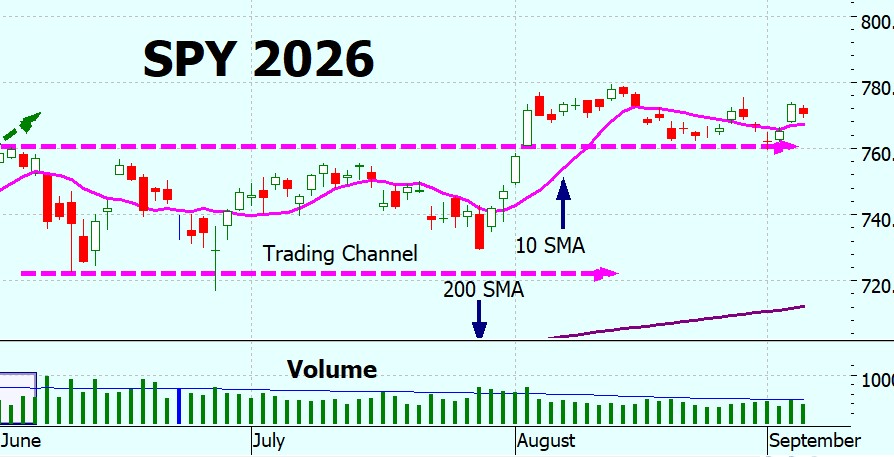
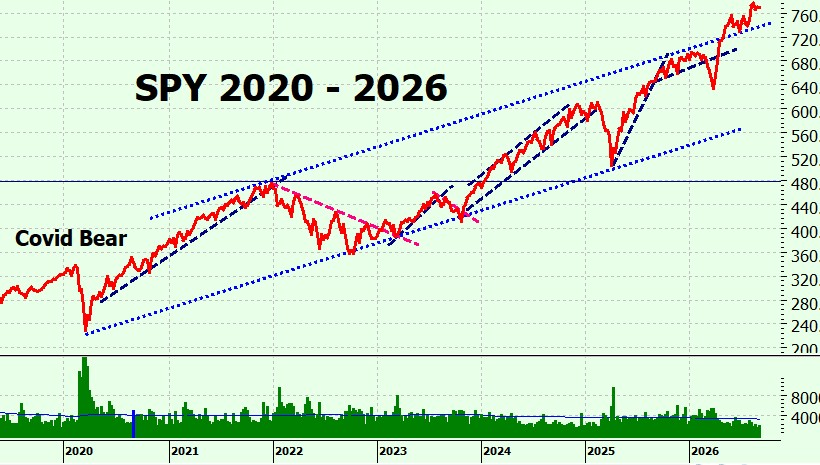
Longer term, the uptrend seems to be holding.
SPYG Charts
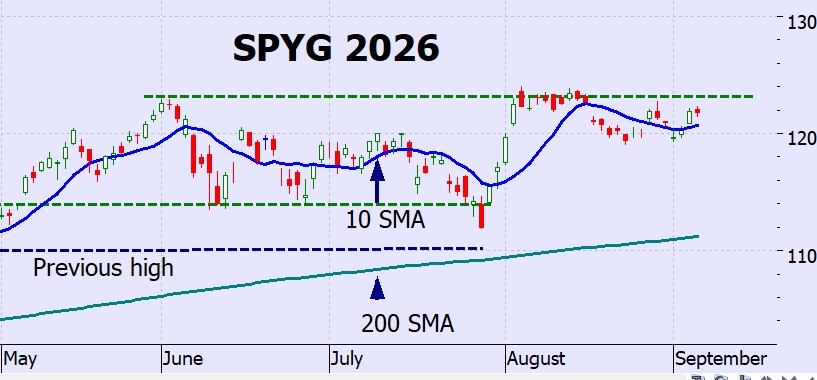
SPYG is still unable to get past resistance around $124.
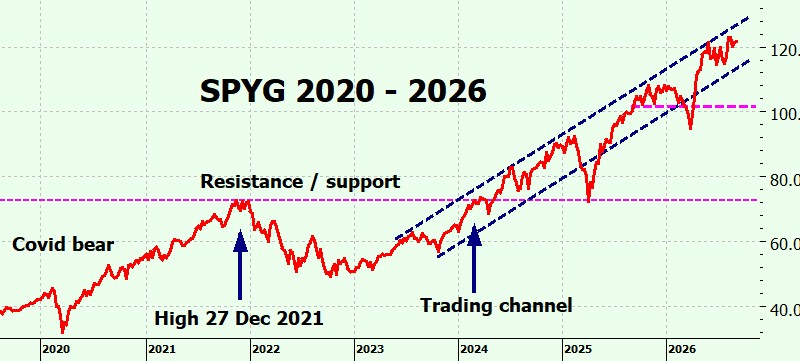
Longer term it is still sitting right in the middle of the trading channel.
QQQ Charts
QQQ is still going sideways – and drifting perilously close to a death cross. The 9-day SMA is moving sideways, while the 100-day SMA continues to rise as lower historical prices drop out of its calculation and are replaced by more recent, higher prices.
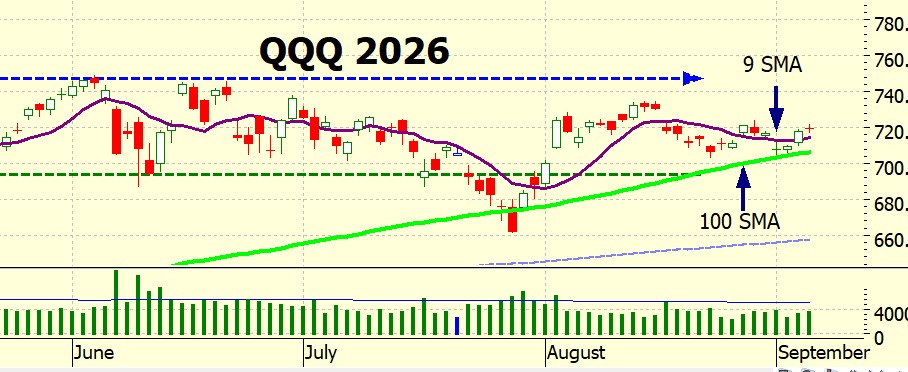
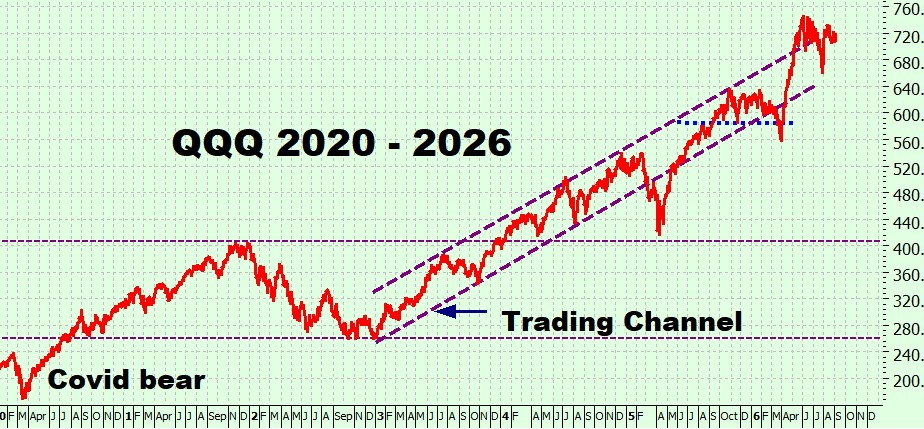
On a side note, I am so fed up with people describing the current situation as a ‘tech bubble’ – does that look like a bubble to you? No? Me neither. But let’s check the longer term chart. Still in the long term trading channel.
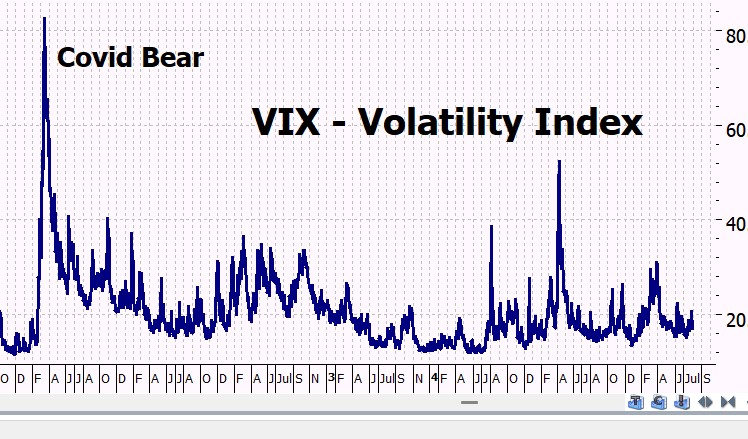
VIX Chart – Volatility
The VIX is unremarkable too.
ITMeter

The week ahead . . .
Inflation will dominate the holiday-shortened week, with producer prices on Thursday and the more important consumer inflation report on Friday. Oracle and Adobe head the earnings calendar.
Monday 7 September
Announcements: Labor Day. US stock markets closed.
Earnings: No major earnings announcements.
Tuesday 8 September
Announcements: New York Fed Survey of Consumer Expectations, quarterly financial reports.
Earnings: GameStop, Casey’s General Stores, ServiceTitan.
Wednesday 9 September
Announcements: Employer Costs for Employee Compensation, Quarterly Services Survey.
Earnings: No major earnings announcements.
Thursday 10 September
Announcements: Producer Price Index, weekly jobless claims, wholesale inventories, existing home sales.
Earnings: Oracle, Adobe, 1-800-Flowers.com.
Friday 11 September
Announcements: Consumer Price Index, core CPI, real earnings, preliminary University of Michigan Consumer Sentiment, federal budget balance.
Earnings: Kroger.
Friday’s CPI report is the week’s main event and could materially change expectations for the Federal Reserve’s next move. Thursday’s producer prices will provide an earlier indication of inflationary pressure, while Oracle and Adobe will put AI spending and the outlook for large software companies back in focus.
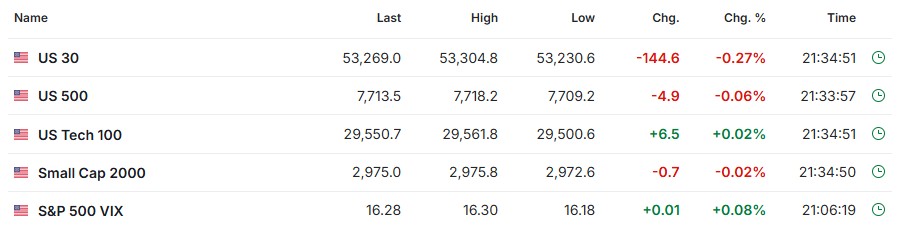
The Futures . . .
The headlines are bad:

But the futures seem unperturbed.
Next Week . . .
I am doing one final check of the ITM Replication Pack. I expect to send out a special email with the download link on Wednesday.
I hope that you will download it and check for yourselves – and, of course, let me know if there are any errors. There is a full change-control procedure in place so nothing will be ‘swept under the carpet’.
The results to the end of June 2026 of investing $1,000 on 29th January 1993 (when SPY started) are:
- SPY (Dividends Reinvested): $32,227
- ITM Base Model (50% strike): $162,184
- ITM Turbo Model (60% strike): $419,719
Pretty unbelievable, I know.
The calculations have been rebuilt and rechecked by AI, but the real test is independent replication by humans. The evidence is there, so please download it, examine it and prove me wrong if you can!
Hoping for a great week!
Heather
Trade the tide not the waves
Q & A
Related Posts
- Unrealized Gains
Unrealized Gains. Well, a nice week for a change. 5 up days in a row,…
- Following the Rules
Following the Rules This year has been the most frustrating year I can remember. The…
- Is It A Bull Trap?
The market is off its lows - but is it a bull trap? So, we’re…

























4 Responses
Thanks for all you do it’s of great value to my trading life. It’s amazing how your information is so helpful.
Thank you Robin – very much appreciated.
h
Hi, Heather:
Thank you so much for all the precious info. Your ITM method is both educational and practical. It’s surely profitable and reliable to me. I sncerely appreciate your update of the weekly blog!
Blessings/KK Tsui
Thank you James – really appreciate your taking the time to let me know.
h