


| The VIX’s Missing Twin |
The Greed Index? OK, that was just a joke. There isn’t one – or at least, there is no widely recognised market equivalent to the VIX devoted specifically to greed.
The VIX is routinely called Wall Street’s Fear Index. Yet fear and greed are supposed to be the two great emotions driving the market.
So why does fear get its own famous index while greed misses out?
Fear and Greed Are Not Equal
Fear and greed sound like mirror images – but they don’t behave like mirror images.
- Greed usually builds gradually. Confidence increases as prices rise, recent gains attract more buyers and fear of losing money is quietly replaced by fear of missing out (FOMO).
- Fear can arrive almost instantaneously.

Consider the COVID bear market. Once investors grasped the scale of the threat, they sold first and asked questions later. From its record high on 19 February 2020, the S&P 500 plunged approximately 34% and reached its low on 23 March – just 23 trading days later.
Greed had taken years to build.
Fear demolished it in little more than a month.
Why Fear Is Stronger
Part of the explanation lies in loss aversion.
We have looked at this research before: a financial loss is commonly estimated to have approximately twice the psychological impact of an equivalent gain.*
That asymmetry also appears in market behaviour. Negative returns generally cause much larger increases in volatility than equivalent positive returns.
A 3% rise may produce excitement.
A 3% fall can produce panic.

There is also a physiological response. Brain-imaging research has found a relationship between financial losses, loss aversion and activity in the amygdala – a part of the brain involved in processing threats and emotional reactions.
In other words, a sudden market fall does not produce a purely analytical response. It can activate the same defensive machinery that helps us respond to danger. Stress rises, clear thinking becomes more difficult and the urge to do something becomes very powerful.
That “something” may be selling in haste – or buying protection only after fear has already pushed option premiums sharply higher. The market fall has triggered the familiar fight-or-flight response, creating a powerful urge to escape the danger or protect against further losses. As a result, protective puts often become most expensive at precisely the time investors feel most desperate to own them.
Two Types of Volatility
Before looking at how the VIX captures that fear, we need to distinguish between two types of volatility.
- Historical volatility measures how much the market has actually moved over a previous period. It looks backwards.
- Implied volatility reflects how much the options market expects prices to move in the future. It looks forwards and is derived from option prices.

The VIX measures implied volatility. More precisely, it uses S&P 500 option prices to estimate the volatility expected by the market over approximately the next 30 days.
Importantly, it estimates the expected size of market movements – not their direction. Nevertheless, because volatility usually rises most sharply when markets fall, the VIX has become known as the Fear Index.
Putting a Price on Fear
When fear strikes, investors rush to protect themselves. Demand for downside put options increases, pushing up option premiums and implied volatility.
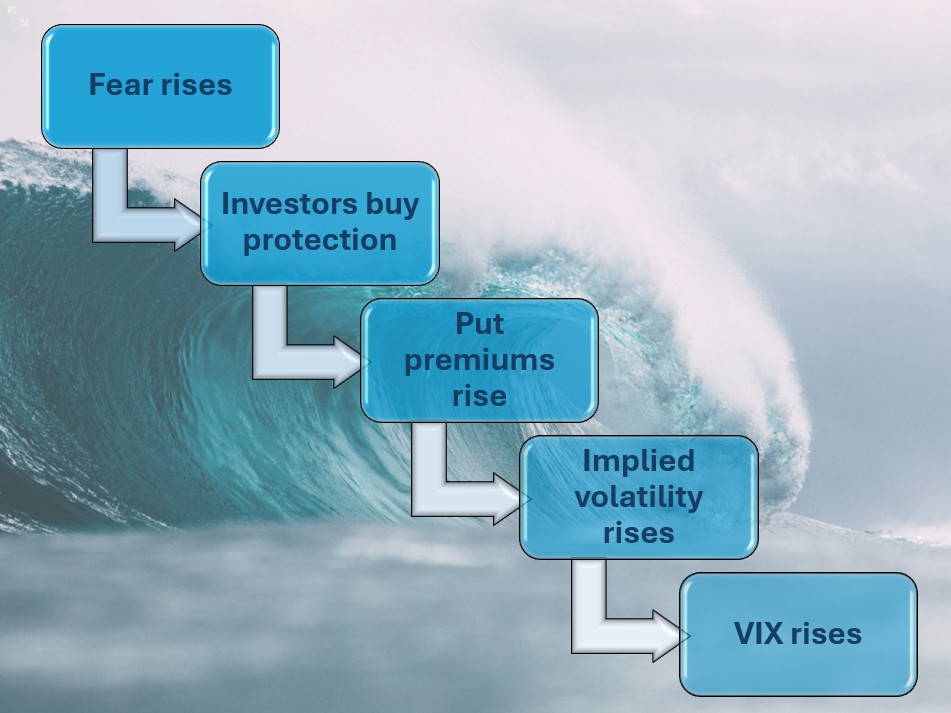
The VIX is calculated using prices from both puts and calls, but the sudden demand for downside protection helps explain why it can rocket upwards during a sell-off.
When the immediate danger passes, the process generally reverses much more slowly. Confidence has to rebuild, demand for protection declines and the VIX gradually subsides.
Greed is usually a slow accumulation of confidence.
Fear is an urgent demand for escape.
The VIX places a market price on that fear.
We can’t help it - or can we?
Panic is not a carefully reasoned investment decision. It is an emotional and physiological response, which is why reactions to sudden market falls are so predictable.
We cannot prevent that first surge of fear. We can, however, prevent it from making our decisions.
That is why we need a mechanical set of rules established before the market falls. When fear tells us to abandon the plan, the rules tell us what the evidence requires.
The VIX may put a price on market fear.
The ITM Plan stops us from paying it.

*Loss aversion forms part of Prospect Theory, developed by Daniel Kahneman and Amos Tversky.
To the markets . . .
Not a great week: the S&P 500 fell 1.4%, while the Nasdaq lost 2.1%. I avoided the doom-and-gloom headlines; the charts told me what I needed to know. The market feels as though it is waiting – but for what? Perhaps Nvidia’s earnings this week will stir it out of its torpor.
SPY Charts
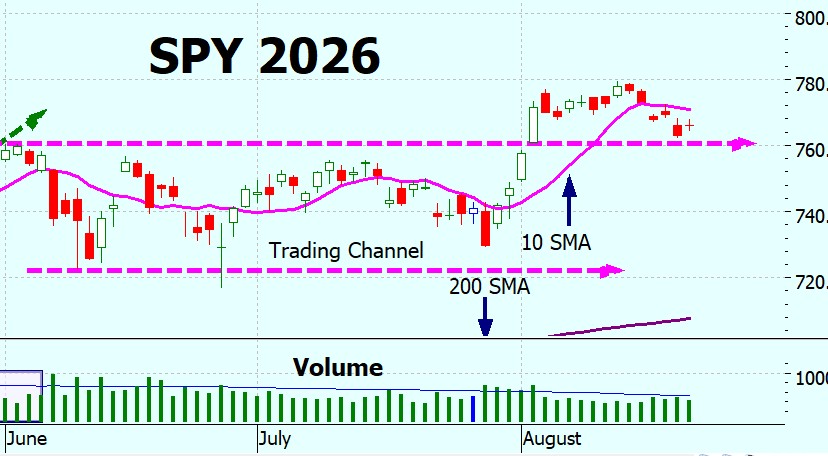
We’re back in a sideways channel again, so the 10-day SMA is flatlining instead of going up. It’s still a long way away from the 200 SMA so a death cross does not seem imminent. 760 seems to be holding as support – but that has only been since the start of August so its too early to really be sure.
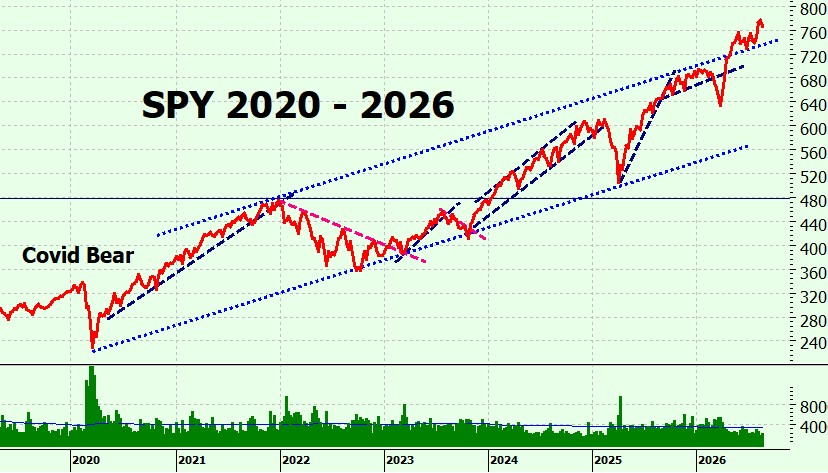
On the longer term chart the uptrend seems to be holding.
SPYG Charts
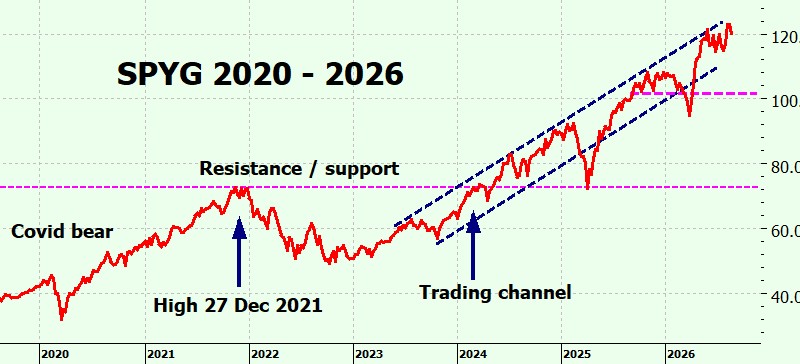
SPYG is encountering resistance at $123, the previous high made on 1 June.
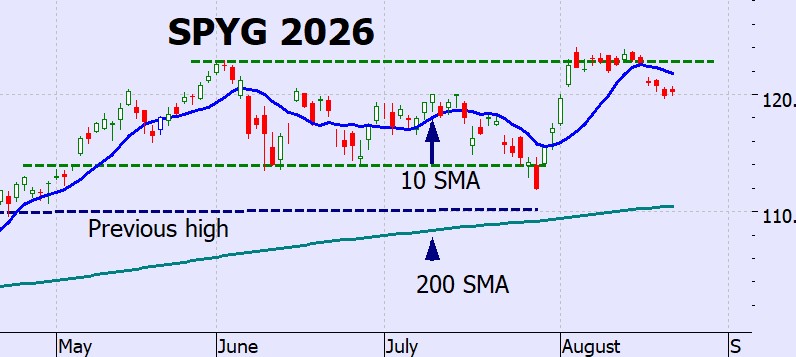
Longer term, it has bounced off the top of the trading channel.
QQQ Charts
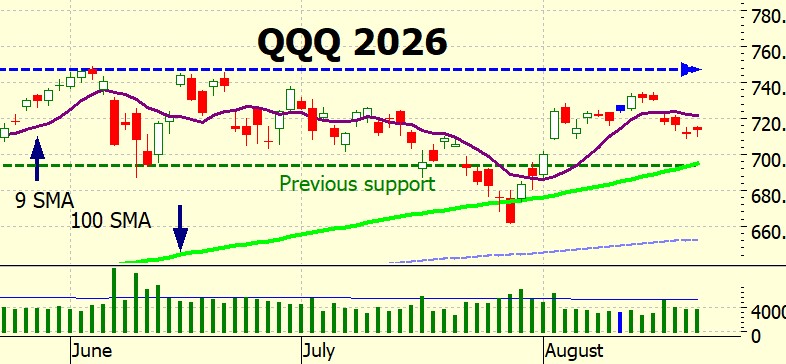
Still going sideways in the channel we’ve been trading in since the start of May. Boring. I understand that not all tech is the same, that some older, previously very successful companies may be hit hard by AI – that investors are worried that investment in AI may not pay off – but I feel that this is just a plateau before it takes off.
Remember, that is just an opinion – the market doesn’t give two hoots what I think and will do whatever it damn well likes!
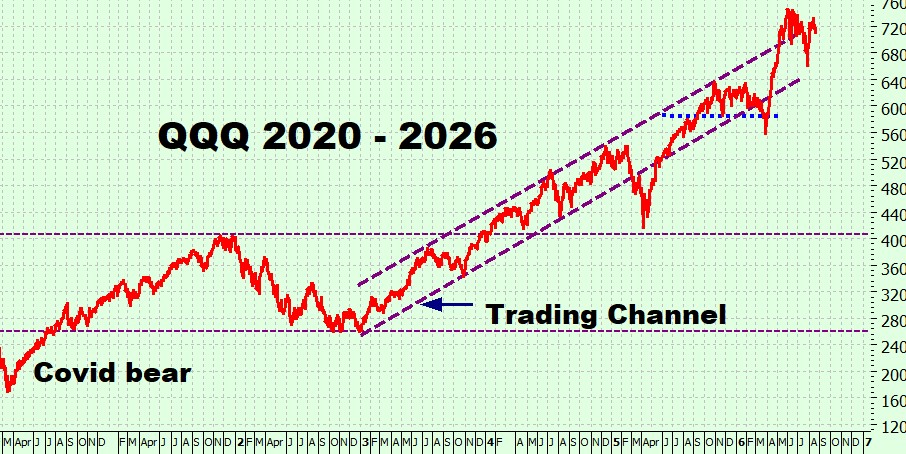
Longer term, it is still near the upper boundary of the channel.
VIX Chart (Volatility)
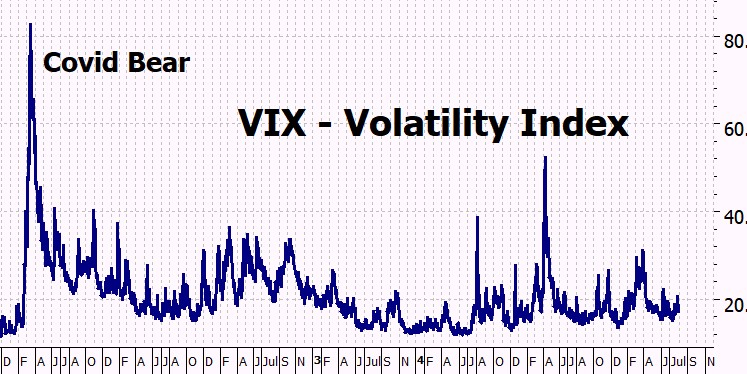
The VIX ended at 17.43, showing little sign of the fear discussed above.
ITMeter

The week ahead . . .
The main market-moving events are likely to be Wednesday’s PCE inflation data and Nvidia earnings, followed by Federal Reserve Chair Kevin Warsh’s address at Jackson Hole on Friday. The week also brings revised second-quarter GDP, consumer confidence and several major retail earnings reports.
Monday 24 August
Announcements: Chicago Fed National Activity Index, Chicago Fed Survey of Economic Conditions.
Earnings: PDD Holdings, Napco Security Technologies.
Tuesday 25 August
Announcements: S&P/Case-Shiller Home Price Index, New Home Sales, Consumer Confidence, Richmond Fed Manufacturing Index.
Earnings: Bank of Montreal, Bank of Nova Scotia, Dick’s Sporting Goods, Box, HEICO, Intuit, nCino, Semtech, Zoom Communications.
Wednesday 26 August
Announcements: Personal Income and Spending, PCE and Core PCE Inflation, Second Estimate of Second-Quarter GDP, Durable Goods Orders.
Earnings: Nvidia, Abercrombie & Fitch, Bath & Body Works, J.M. Smucker, Kohl’s, Li Auto, Williams-Sonoma.
Thursday 27 August
Announcements: Weekly Jobless Claims, Advance Goods Trade Balance, Wholesale Inventories, Retail Inventories; Jackson Hole Economic Policy Symposium begins.
Earnings: Best Buy, Dollar General, Hormel Foods, Marvell Technology, Ulta Beauty.
Friday 28 August
Announcements: Federal Reserve Chair Kevin Warsh speaks at Jackson Hole, University of Michigan Consumer Sentiment—Final, Chicago Business Barometer.
Earnings: No major earnings scheduled.
Wednesday will be the week’s main focus, with PCE inflation, revised GDP and Nvidia earnings. Nvidia’s results will provide an important test of continuing demand for AI chips and infrastructure. Markets will then turn to Federal Reserve Chair Kevin Warsh’s address at Jackson Hole on Friday.
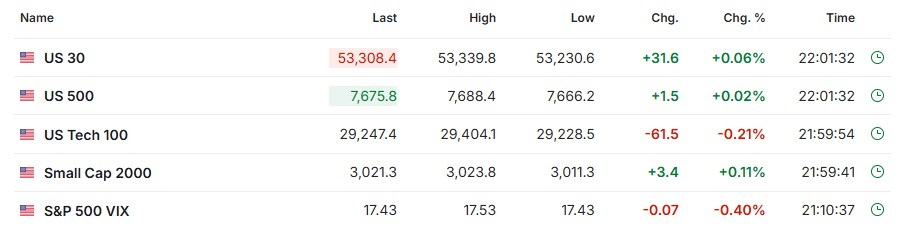
The futures
Tech is down slightly, S&P neutral.
Next week . . .
Why do we use SPY and QQQ? Why not one of the many lower-priced ETFs tracking the same indexes? We’ll look at that next week. And if you have an idea for a blog topic, please let me know in the comments.
Hoping for a great week!
Heather
Trade the tide not the waves.

Q & A
Related Posts
- Pain & Fear
Or Fear & Greed? Most books about the stock market think that fear and greed…
- Market Pessimists
| The Eeyore Effect | We’ve had some heart-stopping days recently when market drops tested…
- QQQ isn't the Nasdaq
| Nasdaq up. QQQ down? | Most people assume that QQQ is the Nasdaq. It…























2 Responses
Heather. What a concise explanation of the VIX. Thank you ! I always love reading your blog on Monday mornings. I especially l look forward to your words next week about “the other index ETFs”.
Thank you again for putting your insights and experience into clear and simple words.
A thousand blessings.
Uncle Dave
Three examples of the “ nervous Nelly “ 1. I missed the boat ( Uncle Bob needed $ for an emergency (?) ) so I couldn’t invest ( beginning of bull ) so I’m scared to get in… 2. I made money SPY omg ( the national debt is at 40 trillion ) one day the bottom will drop out ( where’s my Diazepam ). 3. Uncle Fester watched the “ burning match theory “ and decided to be the last person to grab the match. ♂️4. Dear Ole Dad’s “ if you wanna make a million dollars in the stock market spend two million … r ps watch for a lemming!