| The Eeyore Effect |
We’ve had some heart-stopping days recently when market drops tested our confidence in the ITM strategy. Because I’m in Australia everything happens overnight – so the first thing every morning I reach for my iPad to see where things landed.
And some days it has not been a good way to start the day!
Your Inner Eeyore
Recent research shows that investors consistently assess the likelihood of a catastrophic market crash as far higher than its historical frequency would justify.
In other words – we are all Eeyores. Gloomy, pessimistic, and quietly resigned to impending misfortune. We convince ourselves that the next major crash is always right around the corner.
“It’s snowing still,” said Eeyore gloomily.
“So it is.”
“And freezing.”
“Is it?”
“Yes,” said Eeyore.
“However,” he said, brightening up a little, “we haven’t had an earthquake lately.”
But . . . the weather?
Interestingly, our emotional state influences this risk assessment in surprising ways.
Researchers found that even unusually bad local weather can measurably darken an investor’s mood, causing them to increase their estimated probability of a market crash.
In other words, investors were not simply evaluating risk objectively. Their emotional state was influencing what they believed the risk to be.
Memory Highlights: the 9/11 Effect
Our memories don’t help. They do not treat history neutrally or evenly.
If someone asked you what you were doing a year ago last Tuesday you almost certainly would not remember. But if someone asked you what you were doing on 9/11 you could likely answer in seconds.
Why? Because our memories prioritize the extreme highlights – the events out of the ordinary – while normal, everyday occurrences quietly blend into the background.
Market Memories
A recent study of over 17,000 retail investors found that we process market history in the exact same way. We vividly recall the terrifying crashes and spectacular rallies, while the long, steady stretches where nothing dramatic happened disappear from our minds entirely.
If you were asked about the covid crash you would probably remember the month, the panic and how fast the market fell. But if you were asked about the lovely bull run afterwards – how long it lasted or the percentage it gained – your memory is probably much hazier.
“Good morning, Pooh Bear,” said Eeyore gloomily.
“If it is a good morning,” he said.
“Which I doubt,” said he.
Selective Memory
Our memories are also heavily influenced by what the market is doing right now.
- In a Down Market: Memories of previous market crashes become much easier to recall, making a larger disaster feel inevitable.
- In an Up Market: Memories of spectacular gains come straight to the front of our minds, making further gains feel guaranteed.
We then use those selective memories to form our expectations of what will happen next.
It is rather like judging your entire life from a highlights reel containing only your greatest triumphs and worst disasters. All the perfectly ordinary days – the ones that make up most of a lifetime – have been edited out.
Fear & Greed
Selective memory leaves us vulnerable to both fear and greed. The market mechanics may not have changed, but the evidence our memory chooses to present to us has shifted completely.
Understanding this mental bias is precisely why we rely on objective rules rather than our visceral reaction to a chart:
- Expect the Asymmetry: Recognize that feeling pessimistic during a drawdown is a biological memory response, not a directional forecast.
- Trust the Long-Term Sample Size: Market history is defined by long, quiet stretches of compounding, punctuated by brief moments of volatility.
- Stick to the ITM Plan: The strategy exists specifically to remove emotional perception and memory bias from risk management.
Don't let Eeyore make the decisions
When you check the charts or read the headlines and feel that instinctive urge to worry, remember: your brain is playing the highlight reel.
Stick to the strategy, respect the probabilities, and let the ITM Plan do its work.
We don’t have to stop being Eeyores.
We just need a plan that stops Eeyore making the decisions.
“That Accounts for a Good Deal,” said Eeyore gloomily.
“It Explains Everything. No Wonder.”
To the markets . .
A much better week. About time too!
SPY Charts
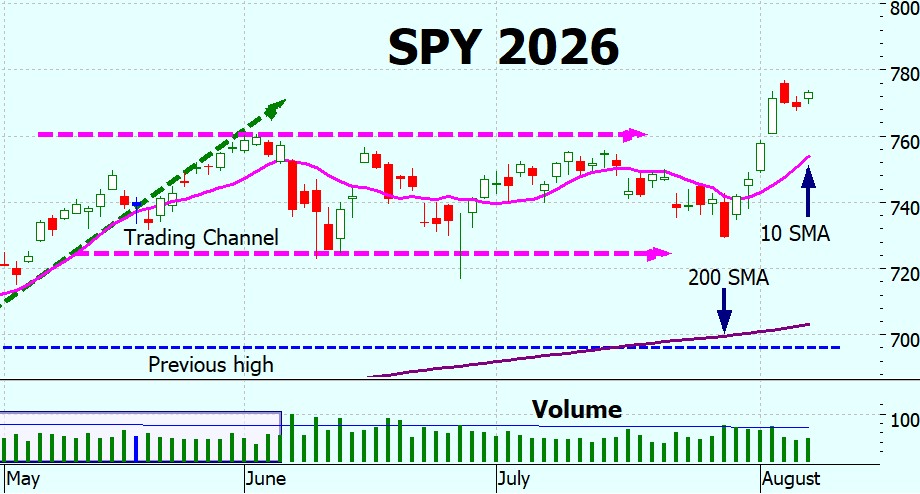
Last week we were hopeful that SPY would break out of its channel – and it has! And in the right direction – up.
A very nice week, really. The two up days (the large green candles) were on higher-than-average volume (100-day SMA) and the three subsequent days with small-bodied candles on lower volume – signaling that investors were more enthusiastic on the up days. It is quite normal for prices to ‘take a breather’ after a few strong up days.
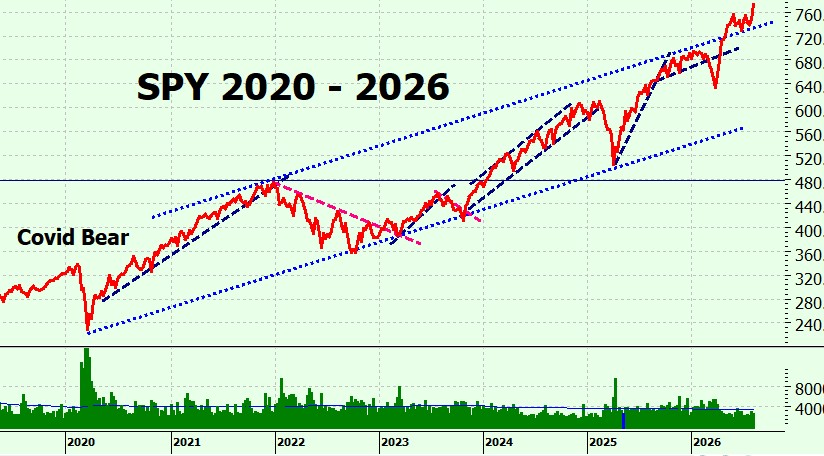
On the long-term chart it seems as though SPY has decided to treat the upper bound of the trading channel as the new support trend line. Well, I’m fine with that!
(Thought: maybe I should put the long term chart on a log scale. What does anyone think? Would that be more helpful?)
SPYG Charts
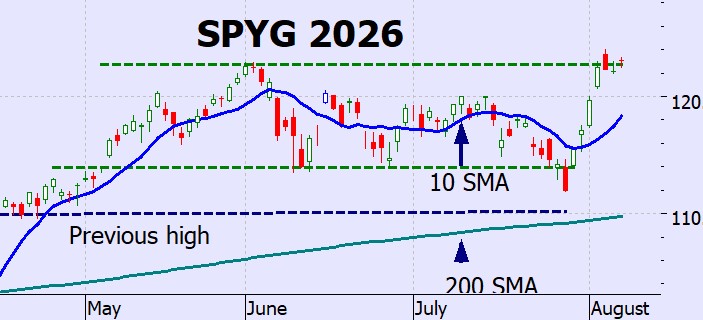
SPYG has also had a very nice week – but hasn’t quite broken out of its trading channel. It has been flirting with it for a few days now. Let’s hope it decides to go north!
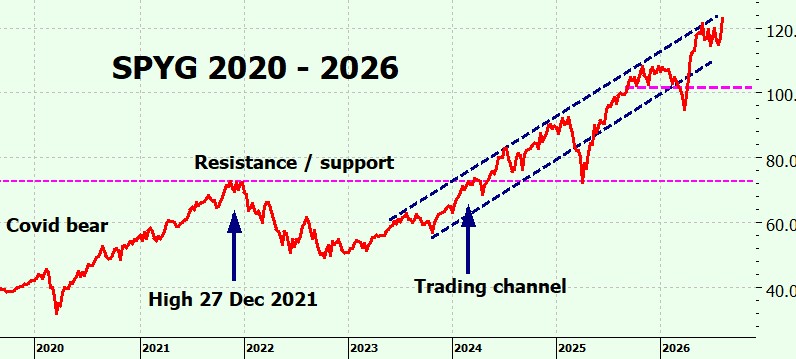
On the long-term chart SPYG is headed toward the top end of the trading channel. It would be nice if, like SPY, it decided to break out and treat it as the new trend line.
QQQ Charts
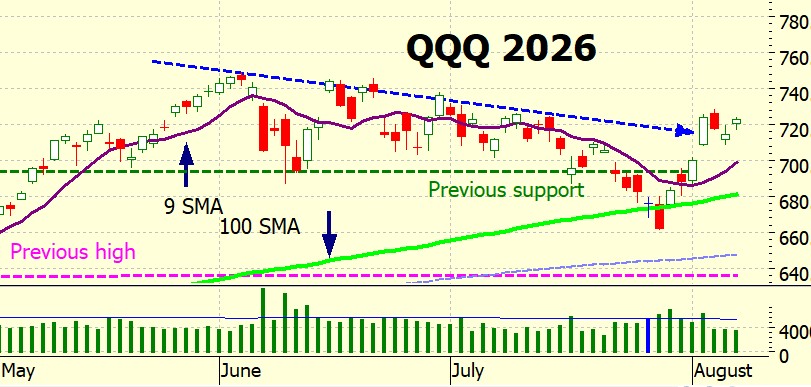
QQQ has also had a nice week – but hasn’t made new highs yet, although it seems to have pierced the blue dashed downtrend line. Which is a good sign – but remember, these are only lines on a chart, drawn by a person (me) not a proclamation from on high.
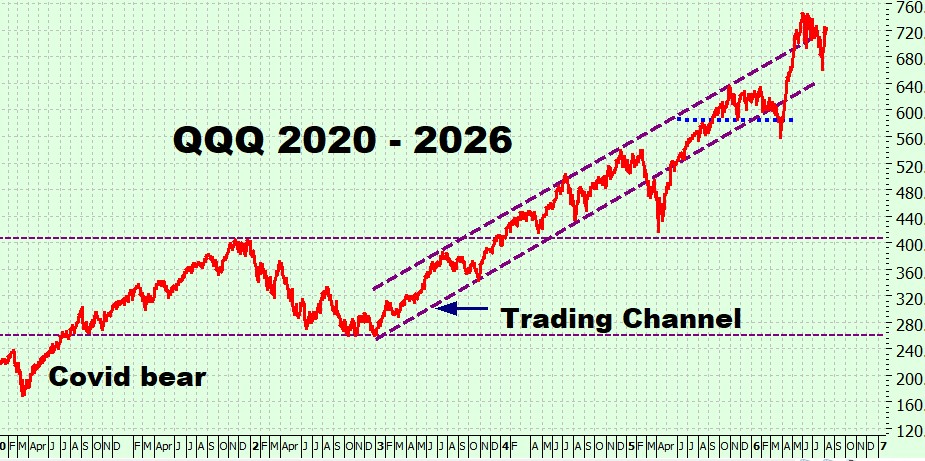
Long term, QQQ is back at the upper bound.
VIX Chart (Volatility)
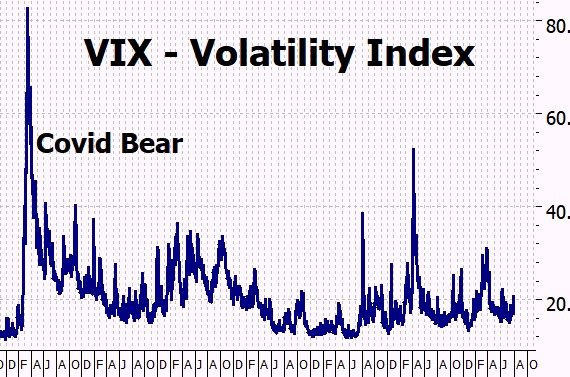
The VIX is sitting around 20, nothing remarkable.
ITMeter
The week ahead . .
The big market-moving days are likely to be Wednesday’s CPI, Thursday’s PPI and Friday’s retail sales.
Monday 10 August
Announcements: No major announcements.
Earnings: Barrick Mining, Monday.com, Rocket Lab, Hims & Hers.
Tuesday 11 August
Announcements: NFIB Small Business Optimism, Existing Home Sales.
Earnings: CoreWeave, Super Micro Computer, Sea, Tencent Music, CAVA.
Wednesday 12 August
Announcements: CPI, Core CPI, Treasury Budget.
Earnings: Cisco Systems, Coherent, Nebius, Brinker.
Thursday 13 August
Announcements: PPI, Core PPI, Weekly Jobless Claims.
Earnings: Applied Materials, JD.com, Tapestry, Birkenstock.
Friday 14 August
Announcements: Retail Sales, Business Inventories, University of Michigan Consumer Sentiment and Inflation Expectations.
Earnings: No major earnings.

AMD will remain in focus after strong results failed to satisfy elevated AI expectations. Cisco should provide another indication of demand for AI networking infrastructure.


CoreWeave, Super Micro Computer, Lumentum, Coherent and Applied Materials will also offer useful evidence about spending across AI cloud computing, servers, optical networking and semiconductor equipment.
The futures . .
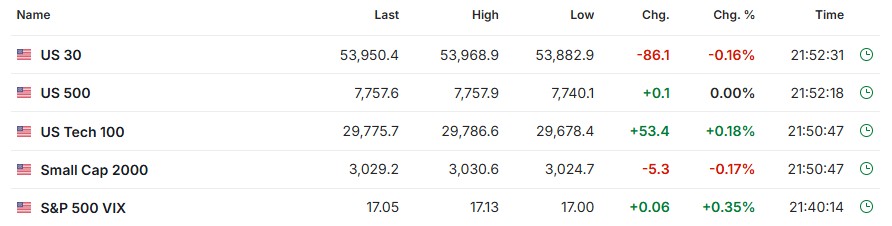
Are pretty neutral – still 12 hours to market open.
Logging back in . . .
It was a nice change to log in to one’s accounts again – I mentioned a couple of weeks ago that when the market was dropping I kept a close eye on what was happening but I deliberately didn’t look at my accounts.
And funnily enough – there’s some research on that! I‘ll go through that in next week’s blog.
Have a great week!
Heather
Trade the tide – not the waves.
Q & A
I think I am up to date with the questions – but if I have missedyou out please post it again here.
Related Posts
- Stock Market Update
As noted in last week’s post the charts are not flashing any major warning signals,…
- What a Boring Market!
Since the start of April, the stock market has been going sideways. While it is…
- Market Makers
Are market makers evil? Are market makers evil? Certainly, a lot of people think so.…